




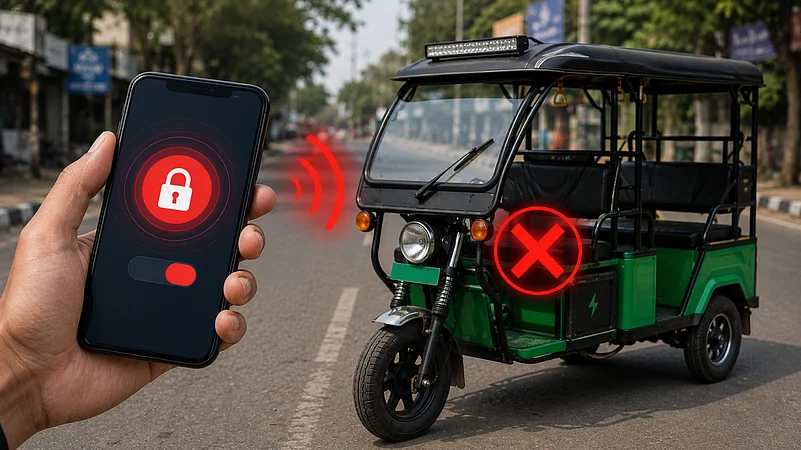
The fast-paced transformation of urban transit across India has long relied on the humble electric rickshaw to bridge the last mile of daily commutes. These small, battery-operated vehicles, often referred to affectionately as tirris in northern tech hubs and metropolitan outskirts, have democratized public transport by offering an affordable, eco-friendly alternative to traditional fossil-fuel transit. However, the lightning-fast adoption of low-cost electric mobility has quietly outpaced the implementation of structural security standards.
A startling technological vulnerability recently burst into the mainstream digital consciousness, shifting from what appeared to be an isolated internet prank into a full-scale national security and economic conversation. The source of this widespread logistical disruption is surprisingly basic, requiring no advanced programming knowledge, specialized black-hat hacking hardware, or backend database exploitation. Instead, everyday pranksters, content creators, and malicious actors have discovered that they can completely paralyze moving public transit vehicles using nothing more than a freely available Bluetooth App utility.
From Harmless Internet Prank to Systemic Crisis
The entire controversy erupted when short-form videos began aggressively circulating across platforms like Instagram, YouTube, and X. In these clips, individuals would approach crowded public roads, open a specific mobile utility tool on their smartphones, and watch as nearby moving e-rickshaws instantly ground to a halt. The drivers, completely unaware of the digital interference occurring just a few meters away, were left stranded in the middle of chaotic traffic junctions, frantically turning their ignition keys and checking physical wiring to diagnose what seemed like a sudden mechanical failure.
For the viewers online, the immediate reaction skewed toward amusement and disbelief, treating the scenario as a harmless, magic-like street trick. But for the thousands of drivers who depend on these vehicles for their daily bread, the viral digital trend introduced an unprecedented, invisible threat to their livelihoods.
The Mechanics of the Diagnostic Vulnerability

At the absolute center of this unfolding technological crisis is a legitimate, consumer-facing mobile application known as BAT-BMS, along with similar alternative utilities like Epoch Li-ion and Lossigy. Under ordinary circumstances, these programs are developed with entirely noble, practical intentions in mind. Created by specialized battery management solution companies, these applications are designed to act as wireless diagnostic dashboards for engineers, fleet operators, mechanics, and individual owners.
When a user pairs their smartphone with a Bluetooth-enabled lithium-ion battery pack, the interface yields highly granular, real-time data regarding the health of the system. It allows a legitimate operator to view the current state of charge, overall cycle life, individual cell voltage variations, internal temperatures, and current flow during active charging and discharging cycles. Additionally, to facilitate safe maintenance or emergency handling, these applications include a master toggle configuration that allows an individual to completely disable the power discharge function, turning off the battery entirely with a single digital tap.
The Fatal Flaw in Budget Manufacturing
The critical engineering failure occurs not within the software code itself, but within the complete absence of a standardized security architecture on the physical battery hardware installed inside thousands of mass-market vehicles. Many budget-friendly electric rickshaws operating throughout regional Indian markets utilize unbranded, mass-produced lithium-ion battery packs that feature integrated Bluetooth chips. To cut manufacturing costs and maximize the convenience of quick repairs, these systems constantly broadcast their wireless presence to any nearby scanning device using standard Bluetooth Low Energy advertising packets.
The fatal flaw is that these cheap, aftermarket battery management systems are manufactured with zero authentication protocols, lacking even the most basic pin code protection, password verification, or physical pairing button requirements. Consequently, when any random individual opens the diagnostic application within a ten-to-fifteen-meter radius of a vulnerable vehicle, the smartphone establishes an open, high-level administrative connection automatically.
Disrupting Power Lines from the Sidewalk
Once this unauthenticated wireless bridge is successfully built, the application gains total, unhindered control over the battery pack’s internal operations. The app can directly communicate with the system’s metal-oxide-semiconductor field-effect transistors, which function as the primary electronic switches controlling the flow of power from the lithium cells to the vehicle’s drive motor. When a prankster standing on a sidewalk taps the discharge toggle on their screen, the application instructs the hardware to immediately open the electrical circuit, breaking the supply line instantly.
The electronic instrument cluster of the moving rickshaw instantly goes entirely blank, the motor dies mid-stride, and the vehicle coasting down a busy highway is left entirely immobilized. Making matters worse, some variations of these battery management systems enter a persistent software lock state after receiving a remote shutdown command, meaning the helpless driver cannot simply turn the physical key off and on again to recover control; they remain completely stranded until the digital circuit is manually re-engaged through the software interface.
Real World Ramifications for Everyday Drivers
The real-world ramifications of this technical oversight stretch far beyond the realm of digital content creation and casual street pranks. For an average electric rickshaw driver, a single day of lost operations can entirely wipe out an entire week of carefully calculated household savings. Reports have emerged detailing how bewildered operators spent hours, and sometimes entire days, pushing their heavy, non-responsive vehicles to local repair shops, losing their entire daily wage and accruing unnecessary debt trying to fix an invisible software problem they did not even understand.
Beyond the immediate financial toll, the safety hazards associated with remotely turning off a moving commercial vehicle in the middle of highly dense, chaotic Indian traffic conditions are extraordinarily high. A sudden, unexpected loss of propulsion while navigating narrow flyovers, crossing busy intersections, or carrying senior citizens and schoolchildren can easily cause catastrophic rear-end collisions, sudden passenger entrapment, and severe localized traffic gridlocks.
Regulatory Interventions and the Global Supply Chain
As these instances transitioned from occasional digital anomalies into an everyday systemic menace, regulatory bodies and government ministries were forced to stage an immediate intervention. The Ministry of Electronics and Information Technology took definitive action by issuing official directives to major global app distributors, ordering both Google and Apple to immediately scrub these specific unauthenticated battery management tools from their respective app stores within the country. Law enforcement agencies across multiple states have also initiated active crackdowns, warning the public that intentionally tampering with a vehicle’s mechanical or electronic operation constitutes a severe, punishable criminal offense that carries steep monetary fines and potential long-term imprisonment.
Government officials have noted that the rapid removal of these primary applications serves as a vital temporary band-aid to stop the immediate bleed of viral copycat trends, but they openly acknowledge that software bans alone cannot permanently rectify a systemic hardware security flaw.
Overcoming the Blind Spots of the EV Revolution
The underlying reality exposed by this unique digital exploit is India’s deep, structural reliance on a complex, highly opaque international supply chain for electronic components. While domestic production lines have successfully scaled the manufacturing of physical vehicle chassis, metal frameworks, and outer fiberglass shells, the high-tech brains of these electric vehicles remain overwhelmingly imported from overseas manufacturing hubs. A massive percentage of the battery management systems, microcontrollers, embedded firmware codes, and internal sensors running through the budget electric vehicle landscape are sourced directly as pre-assembled kits.
Because these sub-assemblies are often white-labeled and distributed through various unorganized secondary markets, local vehicle assembly plants and domestic fleet buyers rarely possess full visibility into the source code, security features, or wireless configuration rules hardcoded into the hardware. The rush to bring affordable electric options to the masses effectively created a massive blind spot where basic wireless convenience was heavily prioritized over fundamental cyber resilience and consumer safety.
Building a Secure Blueprints for Smarter Mobility
Moving forward, the resolution of this vulnerability will require a comprehensive overhaul of how low-cost electric mobility options are certified, inspected, and brought to consumer markets. Automotive researchers and cybersecurity specialists are strongly advocating for regulatory agencies to mandate strict, non-negotiable architectural blueprints for all connected vehicular electronics. Future transport policies must require that any battery pack utilizing wireless diagnostic interfaces features mandatory, secure cryptographic pairing protocols.
This means that the wireless chip inside the vehicle must never accept external configuration commands unless it undergoes an authenticated, physical handshake process, such as scanning a unique, secure QR code physically laser-etched onto the battery housing itself, or inputting a unique, non-default administrative security key. Furthermore, manufacturing guidelines should eventually demand the complete elimination of over-the-air shutdown capabilities on any component that does not feature multi-layered, enterprise-grade cloud authentication.
Securing the Wheels of the Nation
For the current generation of electric vehicle owners, operators, and transport dealers caught in the middle of this transition, proactive self-protection is the only immediate defense against malicious digital interference. Fleet managers and individual drivers are being urged to work directly with trusted, certified battery technicians to inspect their current power configurations. If a vehicle is discovered to be running on an unsecured, open Bluetooth connection, the immediate recommended step is to utilize authorized updates to assign a strong, personalized master password to the hardware configuration, or physically shield the internal wireless antenna to drastically reduce its operational transmission range.
As the country steps firmly into a highly digitized, automated future of smart mobility, this peculiar street-level phenomenon serves as a powerful, unavoidable reminder that true technological progress can never be built on a foundation of compromised security. The rapid transition to clean, accessible energy solutions must always walk hand-in-hand with an unyielding commitment to defending the safety, data privacy, and basic financial survival of the everyday workers who keep the wheels of the nation turning.
Please feel free to share this deep dive with your local transport community and subscribe to our newsletter below for the latest technical updates impacting the modern Indian automotive landscape.
Follow us on instagram – @desibooze to get daily updates.
Also see-