



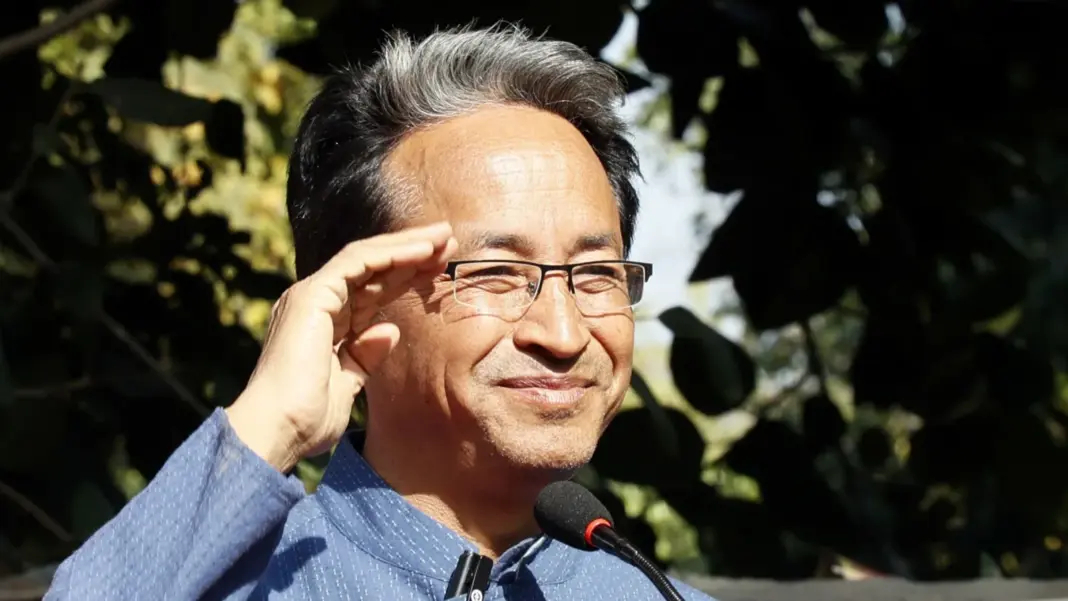
For a generation raised on mainstream Bollywood cinema, the name Sonam Wangchuk evokes a very specific visual: Aamir Khan standing in a remote, high-altitude school in Ladakh, portraying the brilliant, eccentric, and uncompromising inventor Phunsukh Wangdu in the smash hit 3 Idiots. The film immortalized a man who believed that education should spark imagination, not spawn mechanical compliance. Yet, reducing Sonam Wangchuk to a movie character diminishes the true weight of a legendary mechanical engineer, local revolutionary, and global eco-warrior whose real life is vastly more complex, daring, and dramatic than any cinematic fiction.
Today, Wangchuk is at the center of a national media storm. He has stepped down from his research laboratories in the cold deserts of the Himalayas and onto the sweltering, asphalt stage of Delhi’s Jantar Mantar. Surviving strictly on water and salt, his weight has plummeted by over nine kilograms as his indefinite hunger strike passes the grueling three-week milestone. Standing in absolute alignment with millions of Indian students who feel betrayed by widespread national competitive exam paper leaks, he is leading a youth movement that has stunned political observers. His defiant quote from the protest grounds captures his unbreakable spirit: “I will stay alive till July 20 at any cost… if it fails, I will come back as a ghost.” Understanding how a solitary climate innovator became the premier icon of student resistance requires unpacking a life defined entirely by radical self-reliance and community action.
A Strange Childhood in the Ladakhi Wilderness
To understand the core of Sonam Wangchuk’s unique worldview, one must look at his deeply unconventional childhood. Born on September 1, 1966, in the tiny, isolated village of Ulaytokpo in Ladakh, his early years were completely decoupled from standard societal structures. At the time, Ulaytokpo was an oasis of just five households, devoid of roads, electricity, or formal schools.
While most modern biographers view a lack of early schooling as a profound disadvantage, Wangchuk credits this exact isolation with preserving his innate intelligence. He spent his formative years entirely under the tutelage of his mother, a woman who had never attended formal school herself but possessed a deep, holistic understanding of the local ecology and oral literature. Without textbooks or rigid schedules, the young boy learned by watching the seasonal transformations of the Himalayan landscape, witnessing seeds sprout, tracking animal behaviors, and mastering the practical physics of rural survival. As he would later note, bad schooling is often far more destructive than no schooling at all.
The true shock arrived when he turned nine and was sent to a traditional school in Srinagar. The transition was deeply traumatizing. The classrooms were rigid, authoritarian environments where lessons were shouted in Urdu, a language he did not understand, and teachers routinely used corporate punishment to enforce rote memorization. Because he could not follow the spoken instructions, he was branded as a slow learner, dynamic failures, and an outcast. Unable to cope with the psychological humiliation, he eventually ran away. He managed to secure admission into a Kendriya Vidyalaya in Delhi, an institution designed for children from remote border areas. It was here that empathetic teachers recognized his deep curiosity, built up his shattered confidence, and set him back on a path toward engineering.
The Rebellion of a Self-Funded Engineer
Wangchuk’s journey into adulthood was characterized by a fundamental split from familial expectations. When the time came to enter university, his father, a prominent local political figure, wanted him to pursue civil engineering. The logic was simple: Ladakh was an isolated border zone in desperate need of heavy concrete infrastructure, roads, and traditional buildings. However, Sonam’s mind was captivated by the internal moving parts of mechanical engineering—a discipline he believed could yield tools directly adaptable to individual human use.
When his father threatened to entirely cut off all financial support if he did not comply, a nineteen-year-old Wangchuk did something extraordinary: he walked away from his family home and resolved to pay his own way through college. During a crucial summer break before enrolling at the National Institute of Technology (NIT) Srinagar, he traveled back to Ladakh and noticed a large population of desperate students who had failed their board exams and were looking for remedial help.
Renting a public function space, he put out an advertisement for a rapid summer coaching camp. Within weeks, nearly one hundred students enrolled. By utilizing highly engaging, visual, and peer-to-peer teaching strategies, Wangchuk raised enough money in just two months to fully finance three full years of his mechanical engineering degree. He graduated with a B.Tech in 1987. More importantly, this highly profitable summer venture provided him with a dark revelation: the institutional educational system in Jammu and Kashmir was not just tough; it was fundamentally broken, systematically discarding the youth of the mountains.
SECMOL and the Masterclass for Academic Dropouts
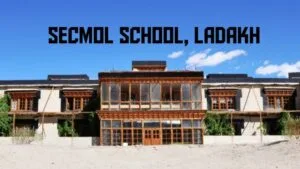
Fresh out of engineering college, Wangchuk rejected standard corporate job placements in metropolitan India. He chose instead to return to Leh, determined to fix the educational machinery that had treated him so cruelly as a child. In 1988, alongside a small, passionate group of local Ladakhi students, he co-founded the Students’ Educational and Cultural Movement of Ladakh (SECMOL).
The statistics confronting them were horrific. In the late 1980s and early 1990s, an unimaginable ninety-five percent of all Ladakhi students failed their state-level matriculation exams. The cause was clear: the government textbooks were imported wholesale from low-altitude, urban areas, filled with references to monsoons, ocean liners, skyscrapers, and tropical fruits that mountain children had never seen. Furthermore, the exams required fluency in English and Urdu, bypassing the native Ladakhi language entirely.
In 1998, Wangchuk took SECMOL to its ultimate evolutionary stage by establishing an alternative residential campus in Phey, located about 18 kilometers outside of Leh. He instituted a brilliant, counter-intuitive admissions rule: the primary qualification for entry was that a student had to have completely failed their standard board examinations.
The SECMOL campus became a living utopian experiment in self-governance and functional learning. The students did not just sit in rows reading textbooks; they literally ran the entire facility. They elected a student government body that rotated power every two months, learning the realities of administrative governance. They managed the campus budget, published their own regional magazine, took turns cooking meals, and handled cow-farming and organic crop production.
Most importantly, the campus served as an ongoing laboratory for green engineering. The students worked directly with Wangchuk to build passive solar mud structures that stayed beautifully warm during sub-zero winters using zero fossil fuels. They designed and assembled localized solar trackers, wind power networks, and gray-water recycling systems. To scale up this systemic overhaul, Wangchuk launched Operation New Hope in 1994, which brought together village councils, civil groups, and the state government to rewrite textbooks in local contexts and re-train over 700 rural teachers. Within two decades, this radical collaboration achieved the impossible: the Ladakhi student pass rate skyrocketed from 5% to well over 75%.
Harnessing Nature: The Genesis of the Ice Stupa

While his educational reforms reshaped the demographic trajectory of Ladakh, Wangchuk’s mechanical mind never stopped looking at the physical threats endangering his home region. As global temperatures rose across the 21st century, the ancient Himalayan glaciers began retreating rapidly due to severe climate change. This disruption triggered a terrifying seasonal water crisis for Ladakhi farmers. In the crucial months of April and May, when fields desperately needed to be irrigated for the spring sowing of barley and peas, the glaciers remained frozen upstream, cutting off water supply. Conversely, by late June and July, the summer sun caused flash glacial melting, leading to massive floods that washed away precious topsoil.
Inspired by an older local engineer named Chewang Norphel, who had experimented with flat, horizontal artificial glaciers in high-altitude shade zones, Wangchuk sought to design a more resilient, low-altitude solution. He realized that flat sheets of ice melted too quickly because they exposed an immense surface area to the direct warmth of the spring sun. To minimize melting, the ice needed a geometry that offered the maximum volume with the minimum possible surface area exposure: a sphere or a cone.
In the winter of 2013, Wangchuk and his SECMOL team launched the Ice Stupa project. The mechanics were elegantly simple and entirely gravity-driven, requiring absolutely no electricity or mechanical pumps. They laid a pipeline from a high-altitude stream down to a nearby village valley. Because of the massive drop in elevation, a massive head of hydrostatic pressure built up within the pipe. When the water reached the valley, it was directed upward into a vertical pipe, shooting out of a nozzle into the sub-zero night air like a fountain.
The fine mist froze instantly as it fell, building up layer upon layer over a framework of local sea-buckthorn twigs. Over months, this process formed a colossal, cone-shaped mountain of ice that closely resembled a traditional Buddhist religious monument—hence the name “Ice Stupa.”
Because of their unique conical shape, these structures presented very little surface area to the vertical rays of the spring sun. While flat ice sheets vanished within days, the Ice Stupas melted slowly and steadily from the bottom up across April and May, releasing millions of liters of clean water directly into local irrigation channels exactly when the community was on the brink of drought. This simple, low-cost engineering masterpiece gained global adoration. In 2016, Wangchuk was awarded the Rolex Award for Enterprise in Hollywood, utilizing the massive prize money to establish the Himalayan Institute of Alternatives, Ladakh (HIAL)—a hands-on university focused on sustainable mountain development.
Environmental Activism and the Battle for the Sixth Schedule
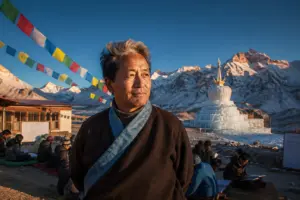
As the years rolled on, Wangchuk realized that individual localized inventions were no longer sufficient to save the delicate ecosystems of the high Himalayas. The geopolitical landscape of the region shifted fundamentally in 2019 when the government of India revoked Article 370, separating Ladakh from Jammu and Kashmir and turning it into a distinct Union Territory without its own legislative assembly.
While the local populace initially celebrated their administrative independence from Srinagar, a deep anxiety quickly took hold. Without a local legislature to pass protective zoning laws, the fragile mountain ecosystem, ancient tribal lands, and finite water reserves were left completely open to large-scale industrial mining, unregulated commercial tourism, and massive corporate exploitation.
Wangchuk stepped forward as the preeminent, non-confrontational voice of regional resistance. He began demanding that the central government fulfill its earlier promises to incorporate Ladakh under the Sixth Schedule of the Indian Constitution. The Sixth Schedule allows for the creation of Autonomous District Councils, giving indigenous tribal communities the legal authority to manage their own land, forests, water resources, and cultural preservation.
To draw national and global attention to this critical environmental struggle, Wangchuk went on a historic 21-day climate fast in Leh during the freezing winter of early 2024. Surviving in temperatures that regularly plunged to -15°C, sleeping out in the open on a simple cot, his physical sacrifice unified the region. Thousands of ordinary citizens, Buddhist monks, and local nomadic herders walked out into the freezing streets to fast alongside him. The movement was a brilliant masterclass in peaceful satyagraha, proving that he was fully willing to put his own biological survival on the line to safeguard the long-term ecological future of his people.
Jantar Mantar 2026: Leading the Student Revolution
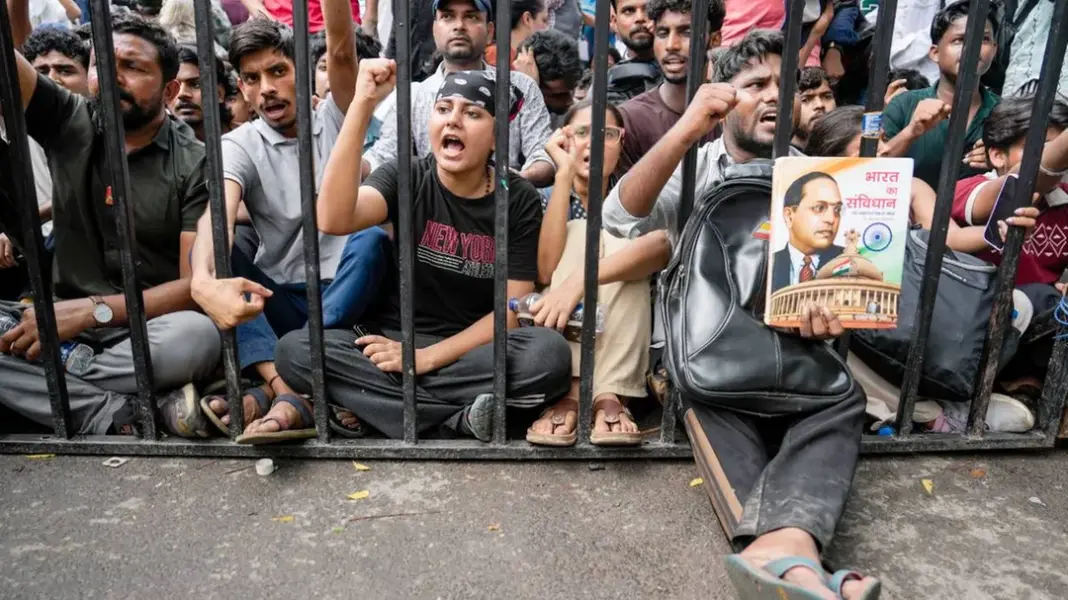
The current chapter of Sonam Wangchuk’s biography is perhaps the most surprising and radical pivot of his entire career. In June 2026, a massive political scandal erupted across India regarding widespread systemic irregularities, institutional corruption, and institutionalized paper leaks in high-stakes national competitive examinations, including the NEET-UG exams. Millions of middle-class and working-class students who had spent years studying in grueling coaching centers suddenly found their futures destroyed by deep bureaucratic corruption.
In response, a digital-first, youth-centric activist group emerged on social media, jokingly calling themselves the Cockroach Janta Party (CJP). The name was a dark, satirical reaction to a public comment that dismissively compared unemployed Indian youth to disposable pests. What began as an internet meme quickly coalesced into an angry real-world protest movement.
Recognizing a profound structural injustice that mirrored the educational failures he had fought against his entire life, Wangchuk left his beloved mountains and traveled down to the capital city. On June 28, 2026, he officially joined the CJP protesters at Delhi’s historic Jantar Mantar, launching an indefinite hunger strike until systemic accountability is enforced, the student victims are compensated, and the leadership responsible steps down.
As his fast enters its final, highly dangerous physiological phase, the capital city has become an absolute pressure cooker. Senior political figures from across the ideological spectrum, alongside prominent national authors and artists, visit his simple protest tent daily to check on his health. The Delhi High Court has taken up active public interest litigation to monitor his physical safety, as medical teams issue daily warnings of imminent multi-organ distress.
Yet, even in a state of severe biological depletion, Wangchuk remains the ultimate educator. He spends his waking hours talking directly to the students surrounding him, preaching the values of absolute non-violence, structural transparency, and digital organizing. He has successfully transformed a chaotic, angry student protest into a highly disciplined, mature national conversation about the ethical future of the nation’s human capital.
The Eternal Philosophy of Sonam Wangchuk
Sonam Wangchuk’s life story cannot be measured merely by the long list of prestigious medals he has received, such as the Ramon Magsaysay Award, the Terra Award for Earth Architecture, or the UNESCO Chair for Earth Architecture. Instead, his true impact is written in the resilient infrastructure he has left behind: in the hundreds of mountain dropouts who became highly successful green entrepreneurs, in the artificial glaciers that feed downstream farms, and in the millions of modern students who now view him as their ultimate moral anchor.
His entire biography serves as an ongoing challenge to conventional definitions of success, wealth, and progress. He has consistently demonstrated that the most elegant solutions to our greatest global crises do not require hyper-expensive, high-carbon Western technologies; they require a deep, humble, and scientific alignment with the laws of nature and human empathy. Whether he is shaping mud bricks in a frozen mountain valley or facing down a hostile administrative apparatus in the heart of New Delhi, Sonam Wangchuk remains an irreplaceable force of nature—a living testament to the fact that one individual with clear intent, an engineering mind, and a willingness to sacrifice can fundamentally rewrite the future of a nation.
For all updates follow us on instagram @desibooze.
Also see-