


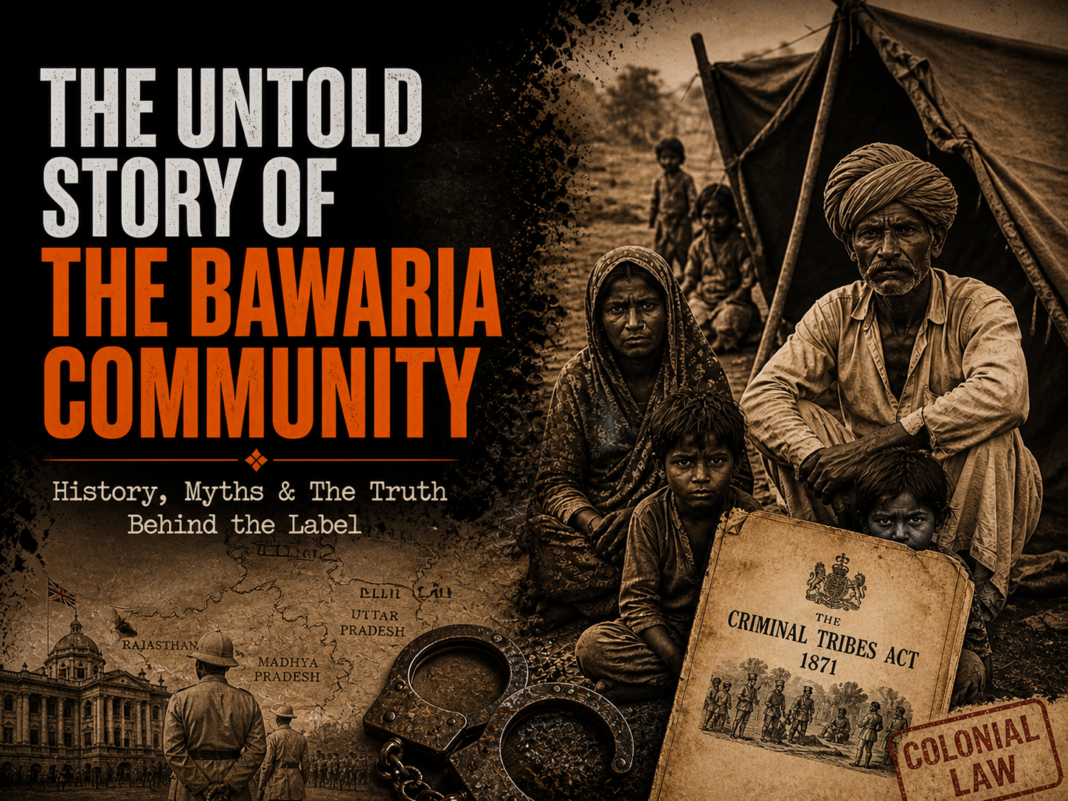
The phrase “Bawaria gang” has become a recurring label in Indian crime narratives, shaping what is now widely referred to as the bawaria gang narrative in india. It is often associated with highly coordinated thefts, inter-state operations, and a mysterious network that appears to evade law enforcement with ease. In popular storytelling, the group is described as organized, mobile, and trained across generations.
However, this widely circulated narrative is not rooted purely in contemporary crime patterns. Its origins lie in a deeper historical context shaped during colonial rule, reinforced by administrative practices, and sustained through decades of social perception.
Understanding the Bawaria community requires moving beyond simplified crime-based descriptions and examining the intersection of history, law, policing, and media representation.
Historical Background of the Bawaria Community
The Bawaria (also spelled Bawariya) community is traditionally categorized among India’s nomadic and semi-nomadic groups. Historically, such communities were engaged in occupations linked to forests and mobility, including hunting, gathering, and trading.
Geographically, Bawaria populations have been documented across multiple regions, including Rajasthan, Haryana, Uttar Pradesh, Madhya Pradesh, and parts of North India. Their lifestyle often involved seasonal movement, which was common among nomadic communities before the formalization of modern state boundaries and administrative systems.
Unlike settled agrarian populations, nomadic groups did not conform to fixed land ownership patterns or permanent residency, which later became a significant factor in how they were perceived by colonial authorities.
The Criminal Tribes Act of 1871 and Its Impact
A major turning point in the history of the Bawaria community came with the introduction of the Criminal Tribes Act.
This law allowed the British administration to classify entire communities as “criminal tribes.” The classification was not based on individual criminal acts but on the assumption that certain groups were inherently predisposed to criminal behavior.
Key provisions of the Act included:
- Mandatory registration of members of notified tribes
- Restrictions on movement and settlement
- Continuous surveillance by local authorities
- Penal action for violation of administrative controls
The law effectively institutionalized suspicion against entire communities. Individuals born into these groups were automatically subjected to scrutiny, regardless of personal conduct.
For communities like the Bawarias, this resulted in long-term marginalization and systemic exclusion from mainstream economic and social structures.
Post-Independence Developments and Denotification
After India gained independence, the Criminal Tribes Act was repealed in 1952. Communities previously labeled under the Act were officially “denotified,” meaning they were no longer classified as criminal by law.
However, denotification did not eliminate the social consequences of decades of institutional labeling.
Several issues persisted:
- Continued police surveillance under alternative legal frameworks
- Lack of access to education and employment opportunities
- Social stigma associated with historical classification
- Administrative challenges due to absence of identity documentation
Many denotified tribes, including sections of the Bawaria community, continued to face systemic disadvantages, which influenced their socio-economic conditions in the decades that followed.
The Emergence of the “Bawaria Gang” Narrative
The term “Bawaria gang” began appearing more frequently in police records and media reports during the late 20th and early 21st centuries. It was often used in the context of organized theft, burglary, and inter-state criminal activity.
Several factors contributed to the emergence of this narrative:
1. Mobility Across States
Nomadic or semi-nomadic movement patterns meant that individuals could operate across multiple jurisdictions. This created challenges for law enforcement coordination and led to the perception of organized networks.
2. Use of Aliases and Changing Identities
In some documented cases, individuals involved in criminal activities used multiple identities, making tracking difficult and reinforcing the idea of a structured system.
3. Inter-State Crime Patterns
Police reports occasionally linked similar methods of operation across different regions, which were attributed to specific groups and generalized under a single label.
4. Media Representation
Crime reporting often simplified complex cases by associating them with recognizable labels. Over time, repeated usage of terms like “Bawaria gang” contributed to a fixed public perception.
Understanding Crime Patterns Without Generalization
It is important to distinguish between:
- Documented criminal activities involving specific individuals
- Generalization of those activities to an entire community
Law enforcement agencies in India have recorded cases involving organized theft and burglary networks. However, attributing such activities to an entire community does not reflect the diversity within that group.
Research on denotified tribes indicates that socio-economic marginalization, lack of access to education, and limited employment opportunities can contribute to higher vulnerability to involvement in informal or illegal activities. These factors are structural rather than inherent.
Socio-Economic Conditions and Marginalization
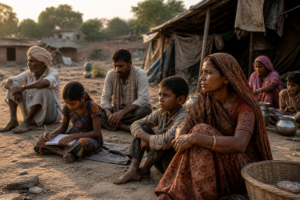
Denotified and nomadic tribes in India, including sections of the Bawaria community, often face:
- Limited access to formal education
- Inadequate healthcare infrastructure
- Lack of stable housing
- Difficulty in obtaining official identity documents
These challenges create barriers to integration into mainstream economic systems.
Government reports and social studies have repeatedly highlighted that marginalized communities are more likely to be associated with informal economies, which can sometimes intersect with unlawful activities. However, this is a consequence of systemic conditions rather than cultural or inherited traits.
Policing, Perception, and Recurring Stereotypes
The historical classification under colonial law has had a lasting influence on policing practices. In some cases, individuals from denotified communities continue to be treated as “habitual suspects,” particularly in regions where historical records exist.
This creates a feedback loop:
- A crime occurs
- Police look at historically labeled communities
- Media reports reinforce the association
- Public perception strengthens the stereotype
Over time, this cycle sustains a narrative that is difficult to challenge, even when evidence does not support broad generalization.
Media, Storytelling, and Viral Narratives
Modern digital platforms have amplified simplified versions of complex social histories. Stories describing communities as secretive networks with inherited criminal skills often gain traction because they are dramatic and easy to consume.
Common elements in such narratives include:
- Claims of generational training in crime
- References to secret languages or coded systems
- Descriptions of highly coordinated operations
While some aspects may be derived from isolated cases, the overall narrative often lacks context and nuance.
The Gap Between Perception and Reality
A significant portion of the Bawaria community today is engaged in non-criminal occupations. Like many other marginalized groups, they participate in informal labor markets, small-scale trade, and service-based work.
The persistence of the “gang” label obscures this reality and affects access to opportunities, social mobility, and integration.
Understanding this gap is essential for a more accurate representation of the community.
Conclusion
The narrative surrounding the Bawaria community in India cannot be understood through a single lens of crime. It is shaped by a combination of colonial history, administrative classification, socio-economic conditions, and media representation.
The label of “Bawaria gang” reflects a broader pattern of how historical policies can influence contemporary perception. It highlights the importance of distinguishing between individual actions and collective identity.
A more informed perspective requires examining both documented evidence and the structural factors that contribute to long-standing narratives.
Stories like these aren’t just about crime — they’re about how narratives are built, repeated, and believed.
If you want more deep-dive stories that go beyond headlines and viral myths, stay tuned with DesiBooze.
Also see-