

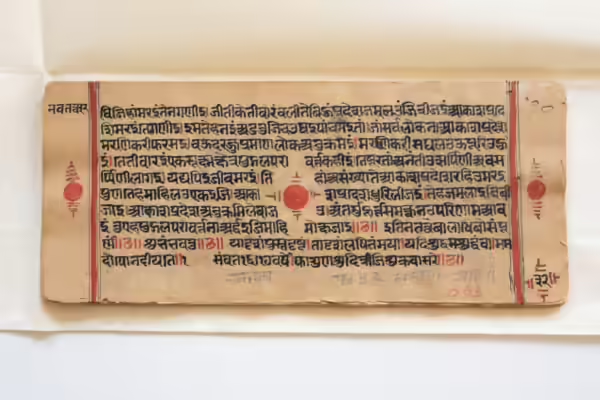
The phrase “UK returns Jain manuscripts” has rapidly gained global attention after the Wellcome Collection in London announced the return of more than 2,000 historic Jain texts acquired during the British colonial era. The decision is being viewed as one of the most significant acts of cultural restitution involving Indian heritage in recent years and has reignited international debate around colonial-era artefacts, historical accountability, and the ownership of cultural history.
Some of these manuscripts date back to the 15th century and are considered among the most important collections of Jain literary heritage outside South Asia. Their return is not simply about transferring ancient documents from one institution to another. Instead, it represents a broader shift in how museums and Western institutions are beginning to confront the ethical questions surrounding collections acquired during imperial rule.
For many observers, this moment reflects something much larger than archival preservation. It highlights how colonialism affected not only economies and politics, but also the movement, ownership, and control of cultural memory itself.
The Origins of the Collection
The collection was originally assembled by Sir Henry Wellcome, the British pharmaceutical entrepreneur and collector whose archives later formed the basis of the Wellcome Collection in London. During the late 19th and early 20th centuries, Wellcome acquired thousands of manuscripts, artefacts, and medical objects from across Asia, Africa, and the Middle East through agents and intermediaries operating under colonial systems.
According to reports and archival records examined by researchers, many of the Jain manuscripts were obtained from regions that are now part of modern-day India and Pakistan. A substantial number reportedly came from a Jain temple in Punjab that no longer exists. The manuscripts were acquired during a period when India was under British colonial administration, a context that has become central to the ethical debate surrounding their ownership.
The Wellcome Collection itself acknowledged that several items within the archive were acquired under conditions shaped by colonial inequality and that the interests of the original custodians were not adequately protected. Such admissions remain relatively rare among major Western institutions and have contributed to the significance of this restitution process.
Why These Manuscripts Matter
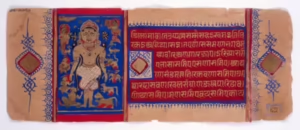
The manuscripts themselves are historically invaluable. They contain religious scriptures, philosophical texts, medical writings, ethical commentaries, and literary works composed in Sanskrit, Prakrit, Gujarati, and other regional languages. Several are richly illustrated and represent centuries-old traditions of Indian manuscript art and preservation.
Jain manuscript culture occupies a unique place in Indian intellectual history. Jain communities historically played a major role in preserving literary traditions through meticulously copied handwritten texts stored in temple libraries and knowledge repositories known as bhandaras. These collections were not merely religious archives; they functioned as centers of learning that preserved developments in philosophy, linguistics, astronomy, mathematics, ethics, and medicine.
Many of the manuscripts returning from the UK are believed to hold deep scholarly importance because they offer insights into medieval Indian society, trade networks, systems of education, and the evolution of non-violence as a philosophical principle. Some scholars have also noted that certain Jain ethical traditions influenced broader currents within Indian political thought, including ideas later associated with Mahatma Gandhi.
The return of these texts has therefore been viewed as both culturally and intellectually significant. It is not simply about recovering physical documents but about reconnecting fragmented histories with the communities and traditions from which they originated.
Colonialism and Cultural Extraction
The story has also become part of a much wider global debate around restitution. In recent years, museums across Europe and North America have faced growing scrutiny over artefacts acquired during colonial rule. Questions once confined to academic circles are now entering mainstream public discourse. Institutions are increasingly being asked whether objects obtained during periods of imperial domination can truly be separated from the systems of power that enabled their acquisition.
This debate has intensified across multiple countries. African nations have demanded the return of looted bronzes and sacred objects. Greece continues to seek the return of the Parthenon Marbles from the British Museum. Egypt has repeatedly raised concerns over ancient artefacts housed abroad. India itself has long sought the repatriation of several culturally important objects removed during colonial rule.
The Jain manuscripts case stands out because of the scale of the return and because the institution involved publicly recognized the colonial imbalance surrounding the collection. Unlike symbolic restitutions involving a handful of items, this transfer includes thousands of manuscripts accumulated over decades.
The issue also exposes the complexity of defining ownership in colonial contexts. Defenders of large Western museums often argue that artefacts were legally purchased under the laws of the time and that global institutions help preserve world heritage. Critics, however, argue that legality cannot be separated from the unequal political realities of colonial rule.
A transaction conducted under imperial domination, they argue, cannot automatically be considered ethically neutral.
The Debate Around Legality and Ethics
This distinction between legality and legitimacy has become central to contemporary restitution debates. Many objects removed from colonized regions may not have been stolen in the conventional sense, but they were often acquired within systems where local communities possessed limited power to negotiate, refuse, or preserve their heritage independently.
The return of the Jain manuscripts appears to acknowledge precisely this historical imbalance.
At the same time, the decision reflects changing institutional attitudes toward accountability. Over the last decade, museums have increasingly begun investigating the provenance of their collections more seriously. Public pressure, scholarly research, and changing political attitudes have forced institutions to reassess the ethical dimensions of colonial collecting practices.
For younger audiences especially, museums are no longer viewed simply as neutral spaces of preservation. They are increasingly understood as institutions shaped by history, politics, empire, and power. Questions surrounding where artefacts came from, who removed them, and under what circumstances are becoming impossible to ignore.
Why the Story Resonated Globally

Social media has amplified these conversations significantly. News of the Jain manuscripts’ return quickly spread online, with many users framing it as a long-overdue act of historical correction. Others used the moment to renew discussions around objects such as the Koh-i-Noor diamond and other Indian artefacts held abroad.
The emotional response reflects how deeply colonial memory continues to influence national consciousness in former colonies. For many Indians, cultural objects removed during British rule symbolize not just historical loss but a broader experience of extraction and displacement.
At the same time, some historians caution against reducing every restitution debate to nationalism alone. They argue that cultural repatriation is also about scholarship, preservation, and accessibility. Questions remain regarding how such manuscripts should be conserved, digitized, and made available for future generations of researchers and practitioners.
According to reports, the manuscripts are expected to be transferred in collaboration with Jain organizations and academic institutions involved in preservation and research. This reflects the practical challenges associated with handling fragile historical documents that require specialized conservation methods.
A Shift in How History Is Viewed
Still, the symbolic dimension of the return remains far more powerful than its logistical details.
The decision marks a rare moment where a major institution publicly accepted that cultural collections assembled during empire cannot always be ethically defended through the language of legality or preservation alone. It suggests that historical accountability is slowly becoming part of the museum world’s future rather than merely a criticism of its past.
Whether this becomes a turning point for broader restitution movements remains uncertain. Many of the world’s largest museums continue to resist returning contested artefacts, arguing that they serve a universal educational purpose. Legal barriers in some countries also complicate permanent transfers.
Yet cases like this are likely to increase pressure on institutions globally. Once one collection is returned after acknowledgment of colonial imbalance, demands for transparency surrounding other collections inevitably grow stronger.
For India, the return of the Jain manuscripts carries significance beyond heritage alone. It reflects an ongoing global reassessment of colonial history itself. For decades, imperial collecting was often presented as preservation or scholarship. Today, many of those same actions are being reevaluated through the lens of inequality and cultural displacement.
Conclusion
The manuscripts returning from the UK are centuries old, but the questions they raise are profoundly contemporary. Who owns history? Can cultural memory be separated from the communities that created it? And how should modern institutions respond to the legacies of empire that continue to shape their collections?
There are no easy answers to those questions. But the return of these manuscripts suggests that institutions are beginning to recognize that cultural heritage cannot be discussed without also confronting the historical systems through which it was removed.
In that sense, the significance of this moment extends far beyond the manuscripts themselves. It signals a broader transformation in how the modern world understands history, responsibility, and the enduring consequences of colonial power.
What are your thoughts on the return of these historic Jain manuscripts? Should museums across the world return more artefacts acquired during colonial rule, or should such collections remain in global institutions for preservation and research?
Share your opinion and join the conversation around history, heritage, and cultural ownership.
Follow us on instagram @desibooze for getting daily updates.
Also see-