Home Blog Page 4

Lizard or Capsicum? Bhopal University Canteen Row Goes Viral After Staff’s Shocking Claim

0
bhopal-lizard-food

A bizarre food controversy from Bhopal has exploded online after students at Rajiv Gandhi Proudyogiki Vishwavidyalaya, or RGPV, alleged that a lizard was found in a canteen meal. What turned the incident from disturbing to unbelievable was the response from a staff member, who reportedly claimed the object was not a lizard at all, but merely a piece of capsicum — and then ate it in front of students. The incident was reported on March 23, 2026, with the original complaint linked to a meal served on March 18.

The moment quickly became viral content gold. Videos and reports of the incident spread across news sites and social media, with netizens reacting in disbelief, disgust, and dark humor. What might have remained a local campus complaint has now become one of the internet’s strangest talking points of the day.

What Happened At Bhopal’s RGPV Canteen?

According to multiple reports, students eating at the campus canteen said they noticed what appeared to be a dead lizard in a vegetable dish. They reportedly approached the canteen staff immediately to complain about the food quality and possible contamination. Instead of the matter being calmly investigated on the spot, a staff member allegedly dismissed the claim and said the suspicious object was just a piece of capsicum. In the most shocking twist, he then ate the item himself in an apparent attempt to prove his point.

That one act changed the story completely. It was no longer just about whether a reptile had been found in a curry. It became a full-blown viral spectacle about hygiene, denial, and the kind of unbelievable reactions that instantly fuel online outrage.

Why This Story Went Viral So Fast

The internet loves stories that are shocking, visual, and impossible to ignore. This one had all three. First, there was the basic gross-out factor: the possibility of a lizard in food served to students. Then came the bizarre defense that it was only capsicum. Finally, the staffer’s dramatic act of eating it added the kind of absurd climax that sends a local complaint into national viral territory.

For many people online, this incident perfectly captured a larger frustration around hostel and college food quality. Students across India often complain about poor hygiene, bad ingredients, and lack of accountability in mess and canteen systems. That is one reason the clip struck such a nerve. It was not just weird; it felt familiar to many who have lived through questionable campus meals. NDTV noted that concerns about hygiene and food quality in hostel messes are not new and often trigger demands for stricter monitoring.

More Than A Viral Joke

Bhopal University Canteen Row Goes Viralll

At one level, the story is meme-worthy. “Lizard or capsicum?” is exactly the kind of line the internet turns into jokes within minutes. But beneath the humor is a serious issue. If students genuinely believed contaminated food was served, the incident points to deeper concerns about canteen standards, food handling, and administrative response on campus. Reports also indicate that the controversy raised hygiene and food-safety concerns among students, and at least one report said a committee had been formed to investigate.

That matters because college canteens are not just snack spots. For many hostel students, they are a daily lifeline. Even one serious lapse can damage trust completely.

The Internet Reacts

As expected, reactions online have ranged from outrage to sarcasm. Some people questioned how such a thing could happen in a university canteen. Others focused on the staff member’s strange attempt to settle the matter by eating the item. And many simply could not get over the surreal nature of the clip. The story has become one of those classic viral moments where disgust, disbelief, and comedy all collide at once.

Follow us on instagram @desibooze.

Also see-

Shiv Thakare Wins The 50 India Season 1: How Reality TV Stars Build Unstoppable Fan Bases

0
Shiv Thakare Wins The 50 India Season 1

Reality TV in India is no longer just about drama, tasks, and eliminations. It has become a powerful platform where contestants turn into full-blown public personalities with loyal digital armies behind them. The latest proof of this trend is Shiv Thakare Wins The 50 India Season 1, a moment that has once again shown how fan support can shape the journey of a reality show star.

Shiv Thakare lifting the trophy after defeating strong contenders like Mr. Faisu, Rajat Dalal, and others is not just another winning headline. It is a story of consistency, popularity, and connection with the audience. Over the years, Shiv has built a name for himself as someone who understands how reality shows work. He knows how to stay visible, how to handle pressure, and most importantly, how to keep viewers emotionally invested.

Why Shiv Thakare’s Win Matters

When a contestant wins a reality show, it usually reflects more than just performance inside the competition. It also highlights how deeply the audience relates to that person. In Shiv’s case, his victory feels like the result of long-term fan loyalty. His followers have seen him grow across multiple reality platforms, and every appearance has added more strength to his public image.

This win matters because it shows that reality TV success today is built on both screen presence and social influence. A contestant may perform well in tasks, but audience recall, relatability, and public emotion often become the real winning factors.

The Secret Behind Unstoppable Fan Bases

Shiv Thakare Wins The 50 India Season 1Reality Tv Stars Build Unstoppable Fan Bases

Reality stars do not build massive fandoms overnight. It takes time, repeated exposure, and a personality that people remember. Shiv Thakare has managed to create that formula successfully. His journey shows that three things matter most in reality television.

1. Relatable Personality

Fans support contestants they feel connected to. Shiv comes across as someone grounded, expressive, and emotionally readable. Viewers enjoy seeing real reactions more than polished performances, and that creates trust.

2. Consistency Across Shows

One major reason behind Shiv’s fan base is consistency. When a contestant performs strongly across different shows, audiences start seeing them as dependable entertainers. This repeated visibility builds familiarity, and familiarity builds loyalty.

3. Social Media Amplification

Today, no reality show winner exists only on television. Their biggest power often grows online. Fan pages, clips, edits, trending hashtags, and constant discussions make a contestant stay relevant even outside the show. This digital noise keeps their popularity alive and attracts new followers.

Reality TV Has Changed the Fame Game

Shiv Thakare Wins The 50 India Season 1 How Reality Tv Stars Build Unstoppable Fan Bases

A few years ago, film stars dominated mass popularity in India. Now, reality TV contestants are competing for the same spotlight. In some cases, they even create stronger engagement because audiences feel they know them personally. Shows allow viewers to watch emotions, conflicts, friendships, and growth in real time. That creates a stronger bond than scripted entertainment.

This is exactly why stars like Shiv Thakare continue to rise. Their fame is built in front of the audience, not behind a character. People do not just watch them; they invest in them.

Beating Strong Competitors Adds More Weight

Winning against popular contestants like Mr. Faisu and Rajat Dalal makes Shiv’s victory even bigger. These were not weak competitors. They came with their own fan bases and strong public recall. Defeating them proves that Shiv’s connection with the audience remains extremely powerful.

Such wins also strengthen a celebrity’s market value. Brands, event organizers, and digital platforms often notice who can generate buzz. A reality winner with a strong fan community becomes much more than a TV personality. They become a digital influence machine.

What This Means for the Future

Shiv Thakare’s win is another reminder that reality TV is one of the fastest routes to mass fame in India. Contestants who know how to stay authentic, perform under pressure, and build emotional connections can create fan bases that last far beyond one season.

For viewers, this win is a celebration of their favorite star. For the entertainment industry, it is proof that fandom is now one of the strongest currencies in media.

With Shiv Thakare Wins The 50 India Season 1, the message is clear: reality TV is not just creating winners anymore. It is creating brands, icons, and fan-backed stars who know how to stay unbeatable.

Follow us on instagram @desibooze.

Also see-

Dhurandhar 2 Fans Spot Cameraman Reflection in Ranveer Singh Fight Scene and the Internet Cannot Unsee It

0

In the age of pause, zoom, rewind, and screenshot culture, even a one-second movie slip can become bigger than an entire scene. That is exactly what has happened with Dhurandhar 2. Fans watching a fight sequence featuring Ranveer Singh have spotted what appears to be a cameraman’s reflection, and now the internet cannot stop talking about it. What was meant to be an intense action moment has suddenly turned into one of the film’s most discussed viral details.

The reason this is blowing up so fast is simple. Dhurandhar 2 is already one of the most talked-about Bollywood films of 2026, and when a film is under that kind of spotlight, audiences notice everything. According to Times of India and NDTV, sharp-eyed viewers caught a crew reflection in a fight scene, and the moment quickly turned into a meme-fuelled talking point online.

What Fans Actually Spotted

The viral discussion began after viewers claimed they noticed a cameraman or crew member reflected briefly during a fight sequence involving Ranveer Singh. NDTV reported that as the camera pulls back, a crew reflection seems to appear in a mirror for a split second, which viewers believe slipped through the final edit.

That tiny moment was enough to trigger a wave of screenshots, reposts, jokes, and fan commentary. Some people called it a funny editing miss, while others joked that the internet has now become too observant for filmmakers to hide anything. In today’s online movie culture, even the smallest blooper can become a full-blown trend within hours.

Why This Went Viral So Fast

There are two big reasons this moment exploded online. First, audiences love catching details that even big production teams miss. It creates a kind of shared excitement, like fans are participating in the film beyond just watching it. Second, Dhurandhar 2 is already carrying major buzz, controversy, and conversation.

Times of India reported that the film has become a huge discussion point not just for its scale and performances, but also for debates around its politics, presentation, and fan theories. That means any new detail, whether intentional or accidental, gets amplified instantly.

In short, this was the perfect storm: a high-profile movie, a blink-and-miss flaw, and an internet that loves feeling smarter than the edit.

Why Movie Bloopers Keep Winning Online

Dhurandhar 2 Fans Spot Cameraman Reflection In Ranveer Singh Fight Scene And The Internet Cannot Unsee It

This is not just about one reflection. It is about how modern viewers consume films. People are no longer passive audiences. They analyse frames, dissect scenes, compare continuity, and hunt for hidden details. A blooper is no longer just a mistake. It becomes content.

That is why a tiny slip can sometimes get more attention than an official promotional campaign. Fans enjoy finding something “the makers missed,” and once it hits X, Instagram, or Reddit-style discussion spaces, the momentum builds on its own. NDTV noted that users quickly turned the Dhurandhar 2 moment into humorous reactions, with some calling it “peak detailing gone wrong.”

Is This Bad for the Film?

Not really. In fact, moments like this often keep a film in the news cycle longer. Unless the mistake is major enough to ruin a scene, it usually ends up giving the movie extra social media attention. For a film already dominating conversation, a viral blooper can even work like accidental promotion.

That seems to be the case here. Dhurandhar 2 is not being discussed less because of this reflection. It is being discussed more. The viral moment has added one more layer to the film’s online life, and that usually helps sustain audience curiosity. Times of India’s coverage suggests the film is already firmly positioned as one of the year’s biggest cinematic talking points.

What This Says About Internet Movie Culture

This entire episode proves something important: today’s internet audience misses almost nothing. Viewers are faster, more observant, and more participatory than ever before. A reflection that might have gone unnoticed years ago now becomes national entertainment discourse in one afternoon.

It also shows how fandom has changed. People do not just react to films anymore. They investigate them. They zoom in, make memes, debate meaning, and turn even flaws into shareable moments. In that sense, the Dhurandhar 2 cameraman reflection is not just a blooper. It is a perfect example of how online cinema culture works in 2026.

Conclusion

The Dhurandhar 2 cameraman reflection moment proves that no detail is too small for the internet anymore. One tiny visual slip in a Ranveer Singh fight scene has turned into a viral conversation, a meme trend, and another reason people are talking about the film. In modern movie culture, perfection is watched closely — but imperfections often travel faster.

Follow us on instagram @desibooze.

Also see-

Indian Gaming Mom Goes Viral: How One Mother Won the Internet With Her PlayStation Skills

0
Indian Gaming Mom Goes Viral

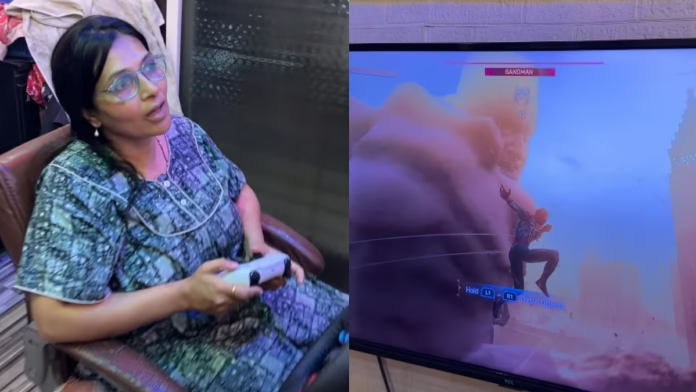
A heartwarming viral video of an Indian mother balancing household responsibilities and PlayStation gaming has captured widespread attention online. The clip, shared by her son, shows her confidently playing racing and action games, challenging the stereotype that video gaming belongs only to younger people. The story has spread quickly because it feels wholesome, relatable, and refreshingly different from the usual viral chaos online.

Why This Story Is Resonating

Indian Gaming Mom Goes Virall

What makes this moment special is not just the gaming itself. It is the contrast people love: a mother managing home life while also enjoying a hobby many still wrongly see as “not for her age group.” That mix of warmth, surprise, and skill is exactly what helps a story travel fast on social media. The viral reaction has been largely positive, with many viewers celebrating her confidence and the bond between mother and son.

Breaking the Gamer Stereotype

Gaming culture is often presented as youth-centric, male-dominated, or overly niche. This video disrupts all three ideas at once. It shows that gaming can be intergenerational, family-friendly, and a genuine form of fun that cuts across age and routine. The “Indian Gaming Mom” moment is trending because it represents a larger shift in how people see hobbies, technology, and family life in modern India.

Why the Internet Loves It

The internet responds strongly to content that feels authentic. This was not a manufactured challenge or a scripted viral stunt. It was a simple family moment that felt real. That authenticity made it more powerful. In a feed full of outrage and controversy, this story offered something lighter: admiration, joy, and a reminder that passion can show up anywhere.

Conclusion

The Indian Gaming Mom viral video is more than just a cute social media moment. It reflects how digital culture is changing, how hobbies are becoming less boxed in by age, and how genuine family moments still have huge viral power. Sometimes, the internet’s biggest winners are not celebrities or controversies — just real people being unexpectedly awesome.

Follow us on instagram @desibooze.

Also see-

Rupee Falls to All-Time Low of ₹94 Against Dollar: Will It Soon Cross the ₹100 Mark?

0
Rupee Falls to All-Time Low of ₹94 Against Dollar

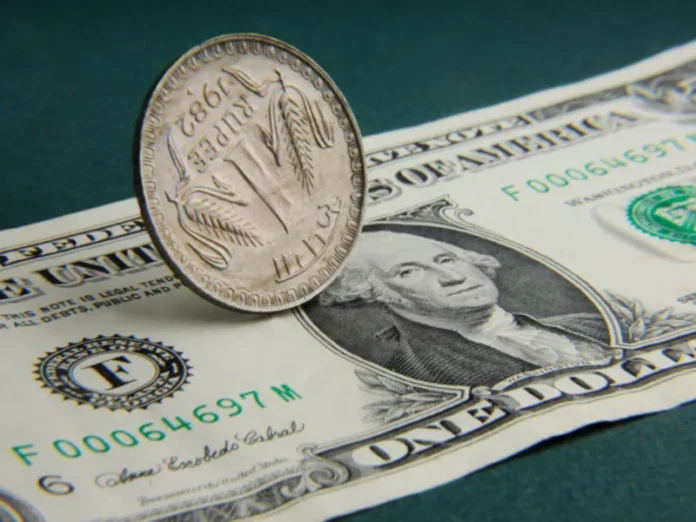
The Indian rupee slipping to an all-time low of ₹94 against the U.S. dollar has triggered serious concern across financial circles and among everyday consumers. Currency movements may sound like a topic only for economists and traders, but the reality is much bigger. When the rupee weakens sharply, the impact eventually reaches fuel prices, imported goods, travel costs, inflation, and business sentiment. That is why the latest fall in the rupee is not just a market update. It is a warning sign for the wider economy.

What has made this moment even more alarming is the speed of the decline. A steep fall in a short period creates panic, raises uncertainty, and sparks questions about how much further the rupee can slide. Naturally, one question is now dominating discussions: if the crisis continues, can the rupee actually head toward the ₹100 mark?

Why the Rupee Is Falling So Fast

A falling rupee usually reflects pressure from multiple sides, and this time the situation is no different. One major factor is the strength of the U.S. dollar. Whenever global uncertainty rises, investors tend to move money into dollar-based assets because they are seen as safer. This boosts the dollar and puts pressure on emerging market currencies like the rupee.

Another reason is crude oil. India imports a large part of its energy needs, and oil is priced globally in dollars. When oil becomes expensive and the dollar remains strong, India needs to spend more foreign currency for the same imports. That increases pressure on the rupee.

Global geopolitical tensions can also make the situation worse. War fears, trade uncertainty, and risk-off investor behaviour often lead to capital outflows from developing markets. When foreign investors pull money out, the domestic currency weakens further.

Why This Matters to Ordinary People

Rupees Low Value

A weak rupee does not stay limited to charts and financial headlines. It directly affects daily life. Imported goods become more expensive, which can raise prices for electronics, gadgets, machinery, medicines, and even certain food items. Foreign travel becomes costlier. Students studying abroad feel the pressure. Businesses that depend on imported raw materials face higher costs, and those costs can eventually be passed on to consumers.

One of the biggest concerns is fuel. Since India imports a significant amount of crude oil, a weaker rupee can make oil imports costlier even if global crude prices do not rise sharply. That creates a ripple effect across transport, logistics, food delivery, and household budgets.

This is why the rupee’s decline matters so much. It is not just about exchange rates. It is about inflation and affordability.

Can the Rupee Really Cross ₹100?

The ₹100 per dollar mark is psychologically huge. Whether the rupee crosses it soon depends on several factors: the direction of the U.S. dollar, global crude prices, RBI intervention, foreign investment flows, and the broader geopolitical environment.

At the moment, crossing ₹100 is not guaranteed, but it is no longer a question people are laughing off. If global tensions continue, oil prices remain elevated, and capital outflows persist, the pressure can intensify. However, the Reserve Bank of India may step in more aggressively to manage volatility and slow down panic-driven movements.

So the ₹100 level is possible, but not inevitable. Much will depend on whether the current crisis eases or deepens.

What the Government and RBI Can Do

Rupee Falls To All-Time Low Of ₹94 Against Dollar

The government and RBI have tools to manage currency stress, even if they cannot fully control global forces. The RBI can use forex reserves to support the rupee, intervene in currency markets, and send calming signals to investors. The government can work on reducing inflation risks, improving investor confidence, and strengthening trade and capital flows.

At the same time, structural reforms matter. In the long run, reducing dependence on imported energy, boosting exports, and improving domestic manufacturing can make the rupee more resilient.

Conclusion

The rupee falling to ₹94 against the dollar is more than just a number. It reflects pressure on the Indian economy at a time of global uncertainty and rising financial stress. The fear around a possible move toward ₹100 is driven not just by the exchange rate itself, but by what that would mean for inflation, imports, fuel, and consumer spending.

For now, the biggest takeaway is clear: when the rupee weakens this fast, everyone should pay attention. Because what starts in the forex market rarely stays there for long.

Follow us on instagram @desibooze.

Also see-

Red Bull F1 Car Gets Indian Aarti and Nimbu-Mirchi Welcome in Viral Clip

0
Red Bull F1 Car Gets Indian Aarti and Nimbu-Mirchi Welcome in Viral Clip

A Red Bull Formula 1 car getting welcomed with an Indian aarti and a nimbu-mirchi ritual is not something you see every day. But that exact combination of speed, culture and desi tradition has now gone viral online. The clip has grabbed attention because it brings together two worlds that usually feel miles apart — elite global motorsport and everyday Indian customs. The result is funny, fascinating and instantly shareable.

What Happened in the Viral Video

In the now-trending clip, a person performs aarti in front of a Red Bull F1 car and places nimbu-mirchi on it, a common ritual believed by many to ward off bad luck or the evil eye. For Indian viewers, the gesture felt instantly familiar. For motorsport fans, it looked surreal. And for the internet, it was content gold.

Why This Clip Worked So Well Online

The viral power of this video comes from contrast. Formula 1 is usually associated with precision engineering, billion-dollar teams and high-speed global glamour. The aarti and nimbu-mirchi ritual, on the other hand, belongs to a deeply local and emotional cultural space.

When the two came together, the clip became more than just funny. It became a perfect symbol of how global brands and Indian traditions often blend in uniquely desi ways. It felt authentic, playful and incredibly shareable.

The Meaning Behind Nimbu-Mirchi and Aarti

Red Bull F1 Car

For many Indian households and businesses, nimbu-mirchi is more than decoration. It is commonly used as a protective symbol against nazar or negative energy. Aarti, meanwhile, is a ritual of blessing and welcome. When these customs were used on an F1 car, the message was simple: even the fastest machine in the world should get a little desi protection before the action begins.

That is exactly why the internet loved it. The clip was not mocking tradition or sport. It was celebrating both in one frame.

Tradition Meets Technology

India’s online audience often loves content where tradition meets modernity, and this video delivered that perfectly. It showed how cultural rituals remain relevant even in highly modern, global spaces. That blend is part of what makes Indian internet culture so distinctive.

Whether you are into Formula 1 or not, the visual of a Red Bull racing machine receiving an Indian-style blessing is the kind of image that stays with you. It is strange, charming and instantly meme-worthy.

Conclusion

The Red Bull F1 aarti video is a reminder that the internet loves moments where culture and spectacle collide. In one short clip, it gave people speed, tradition, humour and identity. And in true desi style, it proved that before any big ride begins, a little blessing never hurts.

Follow us on instagram @desibooze.

Also See-

Meta ID Card Spotted in a Bengaluru Auto and the Internet Has Questions

0
bengaluru-auto-driver

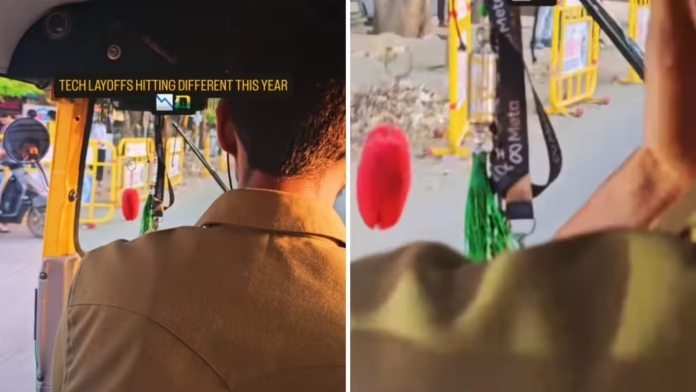
A small detail inside a Bengaluru auto has turned into a full-blown internet mystery. A viral video showing a Meta ID card hanging inside the vehicle has left social media users wondering what the real story is. Was the auto driver once a tech employee? Is it a case of moonlighting, a forgotten card, or simply a random object that the internet overanalyzed? Whatever the truth, the clip has become one of the day’s biggest talking points online.

What the Viral Video Showed

The video itself was simple. It captured a normal auto-rickshaw ride in Bengaluru. But the unusual detail that caught everyone’s eye was a Meta ID card hanging inside. That one object was enough to send users into detective mode. In a city known as India’s tech capital, people immediately began linking the image to layoffs, startup culture, and life in the corporate pressure cooker.

Why Bengaluru Makes This Story Even More Viral

If this had happened in another city, it might still have gone viral. But because it happened in Bengaluru, the story hit differently. Bengaluru is the city of tech offices, coding jobs, startup dreams, and sudden burnout. That is why the presence of a Meta ID card inside an auto instantly became symbolic.

For many internet users, it represented the collision between big-tech ambition and everyday survival. Even without proof, the image fed into a wider public imagination around layoffs, side hustles, and how unpredictable urban work life has become.

Internet Theories Took Over

Bengaluru_Auto_Driver_Meta_Id_Card

Social media did what it does best — it turned a mystery into a community guessing game. Some users guessed the driver could be a former Meta employee. Others suggested the card might belong to a passenger, a relative, or someone who once rode in the auto. A few even joked that this is the most Bengaluru thing ever.

The truth remains unclear, but the uncertainty is exactly what made the video spread. People love stories that let them fill in the blanks, especially when those stories reflect larger anxieties about jobs, identity, and city life.

More Than a Random Viral Clip

What makes this story work is that it feels like a symbol of the times. In one frame, it combines Bengaluru’s tech identity, internet humour, and India’s endless talent for finding a story in the smallest detail. It also reminds us how modern virality often comes from mystery rather than certainty.

This was not a scandal or a celebrity moment. It was just an auto, an ID card, and a city already loaded with meaning. That was enough.

Conclusion

The Meta ID card spotted inside a Bengaluru auto has become a viral sensation because it taps into a bigger mood. It is about curiosity, tech culture, urban hustle, and the stories people project onto everyday life. Whether the explanation turns out to be simple or surprising, the internet has already decided this is one of those clips that perfectly captures Bengaluru in 2026.

Follow us on instagram @desibooze.

Also see-

Mumbai Man Charges ₹250 to Listen to Your Problems and the Internet Cannot Stop Talking About It

0
Mumbai Man Charges ₹250 to Listen to Your Problems

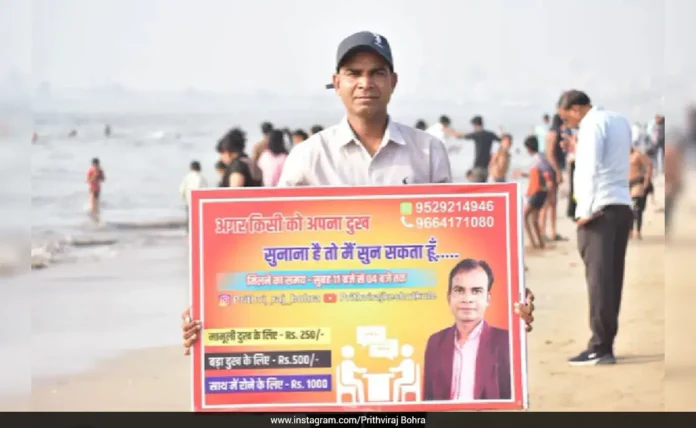
A man in Mumbai has gone viral for turning emotional support into a beachside business idea. In a video now widely shared online, he offers people a chance to talk for ₹250 and even “cry with you” for ₹1,000. What sounds funny at first has actually sparked a deeper conversation about loneliness, stress, and how badly people sometimes need someone who will simply listen. The story has quickly become one of the internet’s most talked-about viral moments.

What Happened in Mumbai

The viral setup is simple but powerful. The man sits by the beach and offers emotional companionship as a paid service. His pricing board caught everyone’s attention because it turned human emotions into a menu-like format. But instead of making people laugh only for the absurdity, it also made many pause and think. The idea spread rapidly on social media, where users reacted with a mix of amusement, praise, and reflection.

Why This Viral Idea Is Hitting So Hard

This story is trending because it feels both bizarre and believable. In a world where everyone is constantly online, many people still struggle to find someone who will genuinely listen without judgment. That is why this “paid listener” concept feels bigger than just a quirky hustle. It touches a real nerve.

Recent reporting in India has also highlighted rising emotional distress and growing demand for mental health support, which helps explain why so many people connected with the video. The viral reaction is not only about a smart business idea. It is also about a very real loneliness crisis hiding in plain sight.

Internet Reactions: Funny, Sad and Surprisingly Supportive

Mumbai Man Charges ₹250 To Listen To Your Problems And The Internet Cannot Stop Talking About It

Online users were quick to turn the story into memes, but many also praised the man for identifying a real need. Some called it genius, others called it heartbreaking, and many said they understood why such a service could work. That is what makes the story so DesiBooze-worthy. It is quirky enough to go viral but layered enough to spark real conversation.

The beach setting added another emotional element to the story. It made the service seem calming and personal, almost like a modern-day confession booth for the stressed-out city crowd.

Is This a Joke, a Business or a Sign of the Times?

Maybe it is all three. On one hand, it is undeniably attention-grabbing and social-media friendly. On the other hand, it reflects a modern reality where emotional support is becoming harder to find in everyday life. Whether people would actually pay for it or not, the fact that so many immediately understood the concept says a lot about the times we are living in.

This viral moment works because it blends humour, hustle culture, and emotional truth into one unforgettable image. That is exactly the kind of internet story that spreads fast and stays in people’s minds.

Conclusion

The Mumbai man charging ₹250 to listen to your problems is more than just another viral clip. It is a snapshot of urban loneliness, internet culture, and India’s endless ability to turn even emotional chaos into a business idea. Funny, strange and oddly relatable, this story has become a perfect example of why the internet loves content that feels both absurd and painfully real.

Follow us on instagram .

Also See-

India Begins Restoring Hindu Temples Abroad, Starting With Indonesia

0
India Begins Restoring Hindu Temples Abroad, Starting With Indonesia

India has taken a major civilisational step by launching a global effort to restore Hindu temples outside its borders, with Indonesia becoming the first country in this mission. The move is being seen as more than just a cultural project. It reflects India’s growing confidence in reviving shared heritage, strengthening historical ties, and expanding its soft power through civilisational diplomacy. The decision has already sparked widespread interest because it connects religion, history, culture, and international relations in one powerful development.

For many, this is not simply about old structures or restoration work. It is about bringing forgotten heritage back into public memory. By beginning with Indonesia, India is also sending a clear message about its intention to rebuild ancient cultural bridges across Asia and beyond.

Why Indonesia Is the First Step

Indonesia is a significant starting point for this initiative because of its deep civilisational links with India. Although Indonesia is now the world’s largest Muslim-majority nation, it has a long and visible Hindu-Buddhist heritage. Ancient kingdoms like Majapahit and Srivijaya were strongly influenced by Indian culture, language, epics, temple architecture, and spiritual traditions.

Even today, this connection remains visible in Indonesia’s historical sites, art forms, names, rituals, and national symbols. Bali continues to be a major centre of Hindu culture, while many parts of Java and other regions still preserve traces of this shared past. Starting the restoration mission in Indonesia therefore makes both historical and diplomatic sense. It shows that India is not imposing something new but helping revive an already existing cultural legacy.

What the Pact Means

India Begins Restoring Hindu Temples Abroad, Starting With Indonesiaa

The reported pact involving the Government of India, the Government of Indonesia, and the Archaeological Survey of India suggests a coordinated effort to support restoration and conservation work. Such cooperation can include technical expertise, archaeological research, heritage preservation, documentation, and structural revival of temple sites.

This kind of partnership is important because temple restoration is not just about rebuilding damaged structures. It requires historical authenticity, expert conservation methods, respect for local laws, and sensitivity toward living communities. With ASI’s involvement, the initiative gains credibility and technical depth, while the partnership with Indonesia ensures that the work remains collaborative rather than symbolic.

Why This Matters Beyond Religion

This development is larger than a religious story. It carries strong cultural and geopolitical significance. In recent years, India has increasingly highlighted its civilisational identity in global diplomacy. From the revival of Nalanda University to the promotion of yoga, Buddhism, and ancient knowledge systems, India has been using heritage as a tool of influence and connection.

Temple restoration abroad fits into that larger vision. It allows India to deepen ties with countries that share historical links with Indian civilisation. It also boosts India’s image as a nation willing to preserve and celebrate ancient global heritage, not just its own domestic monuments.

At the same time, the move may also generate emotional resonance among people who see temples as symbols of continuity, identity, and cultural resilience. For many Indians, this initiative can be seen as a proud moment where the country is reclaiming its historical footprint across the world.

A New Form of Soft Power

Yogyakarta_Indonesia_Prambanan-Temple

Soft power is not only built through trade, cinema, or diplomacy. It is also built through memory, culture, and shared heritage. By helping restore Hindu temples globally, India is creating a new cultural narrative that reaches beyond borders. It is an effort that can strengthen people-to-people ties, attract academic attention, increase tourism potential, and build goodwill in nations with historical Indian connections.

Indonesia is just the beginning. If this mission expands to other countries in Southeast Asia and beyond, it could reshape how India engages with the world through heritage diplomacy. Ancient temples may become symbols of modern partnership.

Conclusion

India’s decision to begin restoring Hindu temples across the globe, starting with Indonesia, is a landmark cultural move with far-reaching meaning. It reflects heritage revival, diplomatic outreach, and civilisational confidence all at once. More than stone and architecture, this mission is about reconnecting the present with a shared ancient past.

As the project unfolds, it may become one of the most visible examples of India’s rising cultural influence in the world. And if done with care, authenticity, and respect, it could mark the beginning of a much larger global heritage revival.

Follow us on instagram to get to know every updates which you should know @desibooze.

Also See-

Dhurandhar 2 Box Office Collection Day 1: Ranveer Singh’s Film Opens Like a Monster

0
dhurandhartherevenge

Dhurandhar 2 Box Office Collection Day 1 has become the biggest Bollywood talking point right now. Ranveer Singh’s much-hyped action thriller has opened to massive crowds, packed theatres, and a wave of online excitement. Multiple reports say the film has delivered a record-breaking start, with India net day-one estimates crossing the ₹100 crore mark and total early numbers going much higher depending on whether paid previews are included.

Theatres Across India Went Full Houseful

From big metro cities to smaller towns, the response on release day looked huge. Reports highlighted houseful shows, strong occupancy, sold-out screens, and overwhelming fan turnout from the very first show. This was not just a “good opening” — it looked like one of those rare releases where the audience had already decided the film was an event.

Advance Bookings Already Gave the Hint

The madness did not begin on release day itself. The buzz had started much earlier with heavy advance bookings and record-setting paid previews. Hindustan Times reported that the film earned ₹43 crore net domestically from paid previews, while India Today reported that early trade numbers pointed to a two-day India total nearing ₹150 crore net. That pre-release momentum gave Dhurandhar 2 Box Office Collection Day 1 the perfect launchpad.

So What Is the Actual Day 1 Number?

This is where the internet got a little chaotic. Some viral posts claimed ₹160 crore on Day 1, while other reports separated preview earnings from the first official day total. Sacnilk listed Day 0 previews at ₹43 crore and Day 1 at ₹102.55 crore, while also showing a combined India net total of ₹139.78 crore and worldwide collection of ₹159.25 crore. Hindustan Times and Times of India both reported that the film had shattered Hindi cinema opening-day records, though exact figures varied by source and accounting method.

Why Did Dhurandhar 2 Explode Like This?

There are a few obvious reasons behind the madness. First, the hype was already sky-high thanks to the franchise value and Ranveer Singh’s star power. Second, the promotions were aggressive enough to keep the film constantly in conversation. Third, once early viewers started reacting positively, the word-of-mouth engine kicked in fast. Put all that together, and the result was pure box office mayhem. The Times of India and India Today both pointed to hype, previews, and audience momentum as key drivers of the historic opening.

Ranveer Singh Just Delivered a Massive Statement

Dhurandhar-2-Reviews

For Ranveer Singh, this opening feels bigger than just numbers. It looks like a loud reminder that when the right film meets the right hype, the audience still turns up in huge numbers. With Dhurandhar 2 Box Office Collection Day 1 already making history, the focus now shifts to whether the film can keep this momentum going through the weekend. Industry coverage suggests the film is already among the biggest Hindi openers ever, and that alone makes this release a major moment for Bollywood in 2026.

Final Word

Whether you count ₹102 crore, ₹139 crore, ₹145 crore, or the viral ₹160 crore claim, one thing is crystal clear — Dhurandhar 2 has arrived with full force. Theatres are packed, fans are hyped, and Bollywood has a new box office monster on its hands. If this pace continues, the film could end up smashing even more records before the weekend is over.

Follow us on instagram @desibooze.

Also see-