




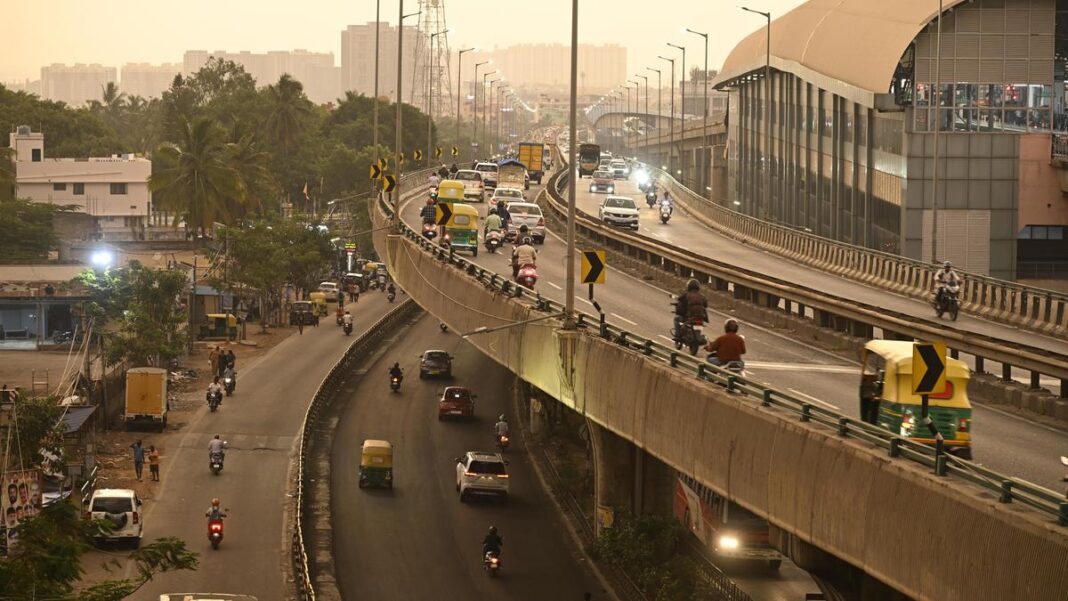
The Bengaluru flyover two-wheeler ban is now an official reality, setting up one of the largest structural shifts in daily urban mobility across Karnataka’s capital. Beginning in September 2026, the Bengaluru Traffic Police (BTP) will enforce a comprehensive, round-the-clock prohibition that bars all two-wheelers, passenger autorickshaws, and three-wheeled goods carriers from navigating two of the city’s premier elevated expressways: the Electronics City Elevated Expressway and the International Airport Road Elevated Corridor (Ballari Road).
This targeted Bengaluru flyover two-wheeler ban forms the cornerstone of a wide-ranging, multi-corridor vehicular rationalization plan enacted across five critical elevated road networks in the city. Designed to address recurring high-speed road fatalities, reduce emergency response paralysis caused by vehicular breakdowns, and logically separate light personal mobility from high-velocity transit, the order is set to redefine the morning and evening journeys of tens of thousands of corporate employees, airport travelers, and delivery executives.
Understanding the Bengaluru Flyover Two-Wheeler Ban Notification
Urban mobility planners and road safety engineers in Bengaluru have long debated the integration of mixed-speed vehicular streams on elevated structures. Elevated highways are built to facilitate uninterrupted, high-speed regional connections that bypass congested surface junctions. However, over the past decade, rapid motorization in Bengaluru led to unprecedented numbers of two-wheelers utilizing these express routes alongside four-wheelers, heavy commercial trucks, and express airport taxi fleets.
The Bengaluru flyover two-wheeler ban represents an administrative intervention to arrest escalating collision rates on roads that lack standard ground-level escape shoulders. Under the statutory provisions of the Motor Vehicles Act and local traffic management mandates, the BTP has notified that two-wheelers—ranging from entry-level commuter motorcycles and electric scooters to high-capacity superbikes—will no longer have access to these selected elevated carriageways.
The notification does not merely restrict movements during peak traffic windows; it establishes an unconditional, 24-hour, seven-day-a-week prohibition designed to eliminate operational ambiguity for enforcement personnel and road users alike.
Phased Implementation: Key Enforcement Dates Across the City
To ensure that the motoring public has sufficient time to adapt their commuting schedules and familiarize themselves with surface-level arterial bypasses, the traffic administration has established a phased rollout for the Bengaluru flyover two-wheeler ban:
+-------------------------------------------------------------+
|               ENFORCEMENT TIMELINE & ROADMAP                |
+-------------------------------------------------------------+
| September 4, 2026 : Airport Road Elevated Corridor (24/7)   |
| September 4, 2026 : Peenya, BGS & Silk Board Freight Rules  |
| September 11, 2026: Electronics City Elevated Expressway    |
+-------------------------------------------------------------+
-
Phase 1 (Friday, September 4, 2026): The Bengaluru flyover two-wheeler ban and three-wheeler restriction will become operational along the International Airport Road Elevated Corridor on Ballari Road. The restricted zone covers the entire elevated stretch between Sanjeevnagar Cross and Vidyashilp Junction.
-
Phase 2 (Friday, September 11, 2026): The Bengaluru flyover two-wheeler ban extends to the 9.98-kilometer Electronics City Elevated Expressway (Hosur Road), prohibiting two-wheelers, passenger autorickshaws, and three-wheeler commercial carriers from ascending the ramps at Silk Board, Bommanahalli, and Electronics City.
The Engineering and Safety Audit Behind the Restriction
The institutional momentum leading to the Bengaluru flyover two-wheeler ban was accelerated by multi-year empirical collision data compiled by the BTP and independent road safety research institutions. Senior traffic officials, including Joint Commissioner of Police (Traffic) Karthik Reddy, pointed out that elevated expressways exhibit unique aerodynamic, structural, and operational hazards that disproportionately endanger two-wheeler riders.
1. Severe Speed Differentials
On unobstructed elevated stretches, airport taxis, private SUVs, and intercity passenger buses routinely clock sustained speeds between 80 km/h and 100 km/h. Conversely, commuter motorcycles, electric scooters with speed limiters, and auto-rickshaws frequently travel between 35 km/h and 50 km/h. This stark speed gap creates frequent rear-end collisions, emergency lane weaving, and severe braking events.
2. Crosswind Vulnerability and Height Hazards
Elevated corridors like the Electronics City flyover rise more than 15 meters above ground level. At these altitudes, two-wheelers are subject to sudden, strong lateral crosswinds, particularly during monsoon squalls and pre-monsoon thunderstorms. Riders encountering sudden gusts often experience stability loss, leading to sideswipes against concrete crash barriers.
3. Breakdown Bottlenecks and Shoulder Absence
Unlike ground-level roads with expansive earthen shoulders, elevated bridges feature narrow emergency margins. When a two-wheeler suffers a flat tire, electrical fault, or engine failure on a single-direction ramp, the stationary vehicle immediately occupies half of an active driving lane. This results in severe traffic bunching and secondary collisions before tow-trucks or mobile patrols can arrive.
Comprehensive Breakdown: Regulations Across Five Elevated Flyovers
While public discussion has centered predominantly on the Bengaluru flyover two-wheeler ban, the comprehensive traffic order introduces calibrated regulations across five strategic flyovers to rebalance commercial logistics and private transit:
| Flyover / Elevated Highway | Two-Wheeler & Auto Regulations | Light & Medium Goods Restrictions | Heavy Commercial Goods (HTVs) | Effective Date |
| Airport Road Corridor (Sanjeevnagar to Vidyashilp) | Banned 24/7 (All Two-Wheelers & Auto-Rickshaws) | Prohibited between 6:00 AM – 10:00 PM | Prohibited between 6:00 AM – 10:00 PM | September 4, 2026 |
| Electronics City Expressway (Silk Board to E-City Gate) | Banned 24/7 (Two-Wheelers, Autos, 3-W Goods) | Prohibited between 6:00 AM – 10:00 PM | Prohibited between 6:00 AM – 10:00 PM | September 11, 2026 |
| Peenya Elevated Corridor (Tumakuru Road Highway) | Banned 24/7 (Passenger & Goods Autos) | Restricted during 7–11 AM & 4–10 PM | Heavy Vehicles Banned 24/7 | September 4, 2026 |
| BGS (Sirsi Circle) Flyover (Mysuru Road to Market) | Open for Two-Wheelers (Standard speed caps) | Restricted during 7–11 AM & 4–10 PM | Heavy Vehicles Banned 24/7 | September 4, 2026 |
| Silk Board–Ragigudda Flyover (Double-Decker Transit) | Open for Two-Wheelers & Light Autos | Standard city traffic hours apply | Heavy Vehicles Banned 24/7 | September 4, 2026 |
Impact on Electronics City Commuters and Alternative Routes
For over a decade, the Electronics City elevated highway served as the primary transit artery for tech professionals, factory engineers, and back-office staff traveling from Bengaluru’s central, southern, and eastern residential hubs to Tech Park clusters in Konappana Agrahara, Electronic City Phase 1, Phase 2, and the Bommasandra industrial belt.
       ORIGINATING HUBS (Koramangala / BTM / HSR)
                           │
                           ▼
              Central Silk Board Junction
                           │
             ┌─────────────┴─────────────┐
             │                           │
  [ elevated flyover ]          [ surface highway ]
  (BANNED FOR 2-WHEELERS)       (MANDATORY 2-WHEELER ROUTE)
             │                           │
             │                  • Madiwala Underpass
             │                  • Bommanahalli Junction
             │                  • Garvebhavipalya
             │                  • Kudlu Gate
             │                  • Singasandra
             │                  • Hosa Road Junction
             │                           │
             └─────────────┬─────────────┘
                           ▼
          Electronics City Phase 1 & 2 / Attibele
With the Bengaluru flyover two-wheeler ban active, two-wheeler riders will no longer be permitted to enter the elevated toll plaza at Silk Board. Instead, all two-wheeled personal vehicles must take the ground-level Hosur Road surface carriageway.
-
Primary Carriageway & Underpasses: Commuters will travel straight through the surface carriageway, utilizing the Madiwala, Bommanahalli, Kudlu Gate, and Singasandra underpasses.
-
Service Lane Integration: Local traffic heading to residential sectors adjacent to Beratena Agrahara, Roopena Agrahara, and Hosa Road must filter through designated service lane entry openings.
-
Travel Time Projections: During off-peak windows, surface travel adds roughly 8 to 12 minutes compared to the elevated highway. However, during the intense morning peak (8:30 AM to 11:30 AM) and evening return peak (5:30 PM to 8:30 PM), riders should expect transit delays ranging between 20 and 35 additional minutes due to traffic lights at Bommanahalli, Kudlu Gate, and Singasandra.
Impact on North Bengaluru and Kempegowda Airport Routes
The northern transit corridor along Ballari Road represents another critical artery reshaped by the Bengaluru flyover two-wheeler ban. The elevated corridor stretching from Sanjeevnagar Cross (near Esteem Mall/Hebbal) up to Vidyashilp Junction in Yelahanka has traditionally allowed riders to bypass surface gridlock across Hebbal, Kodigehalli, and Byatarayanapura.
-
Hebbal Interchange Approach: Two-wheelers heading toward Yelahanka, Devanahalli, or Kempegowda International Airport will stay on the extreme left surface lanes as they cross the Hebbal flyover complex, avoiding the elevated ramp ascent.
-
Surface Transit Corridor: Riders will proceed along the multi-lane surface highway passing through Kodigehalli Gate, Byatarayanapura, Jakkur Cross, and Allalasandra.
-
Airport Passenger Logistics: Delivery riders, courier agents, and airport service employees who commute via motorcycle to cargo terminals and airline utility buildings will need to utilize the ground-level Ballari Road highway, accounting for pedestrian crossings, signalized intersections, and intermediate bus stops.
Modern Automated Enforcement and Penalty Mechanisms
To ensure compliance with the Bengaluru flyover two-wheeler ban, the Bengaluru Traffic Police has structured an automated, technology-driven enforcement apparatus rather than relying solely on manual, on-ground barricading that could inadvertently create bottleneck hazards on high-speed approach ramps.
+-------------------------------------------------------------+
|             AUTOMATED ENFORCEMENT ECOSYSTEM                 |
+-------------------------------------------------------------+
| • High-Resolution ANPR Cameras at all Entry / Exit Ramps     |
| • 24/7 BTP Central Traffic Management Center (TMC) Feeds   |
| • Automated E-Challan Issuance directly to Registered Mobile|
| • On-Ground Mobile Interceptor Squads stationed at Base     |
+-------------------------------------------------------------+
-
Automatic Number Plate Recognition (ANPR): Multi-lane ANPR camera gantries have been installed at the entry ramps of Sanjeevnagar Cross, Vidyashilp Junction, Silk Board toll plazas, and Electronic City exit terminals. Any prohibited vehicle entering the ramp triggers an automated snapshot and logs the violation into the BTP Central Traffic Management Center (TMC).
-
Direct E-Challans: Violators will automatically receive SMS e-challan notices under Sections 115 and 177 of the Motor Vehicles Act for driving in prohibited zones and violating lawful traffic directions.
-
Physical Interceptor Squads: Flying police interceptors and towing cranes will be stationed at base entry points to visually signal unauthorized vehicles away from the ramps and prevent erratic U-turns by riders attempting to escape camera view.
Long-Term Benefits and Urban Commuter Adaptation
While the introduction of the Bengaluru flyover two-wheeler ban initially demands behavioral adjustments from daily commuters, international case studies from Tokyo, Singapore, and Seoul demonstrate that segregating lightweight personal mobility from grade-separated, high-speed elevated expressways produces long-term safety dividends:
-
Drastic Reduction in Fatal Collisions: By removing vulnerable riders from high-speed vehicular corridors, head-on and high-velocity rear collisions on bridges are substantially minimized.
-
Unimpeded Emergency Corridors: Elevated corridors will maintain unhindered speeds for ambulances, fire engines, public transit express buses, and airport transfers without suffering gridlock from localized two-wheeler breakdowns.
-
Encouraging Public Transit Shift: The increased travel time on surface roads may encourage more professionals along the Hosur Road and Ballari Road belts to switch to suburban rail services, the Namma Metro Green/Yellow lines, and dedicated BMTC Vayu Vajra luxury airport bus fleets.
Actionable Advice for Bengaluru Commuters
To navigate the upcoming changes without unnecessary disruption, riders and daily motorists should adopt several proactive commute habits:
-
Recalibrate Daily Alarms: Add an extra 25 to 30 minutes to your departure schedules if you routinely travel along Hosur Road toward Electronic City or Ballari Road toward Yelahanka during morning office rush hours.
-
Use Real-Time Navigation Filters: Update your GPS routing applications (Google Maps, Apple Maps, Mappls) by toggling on the “Avoid Tolls / Avoid Expressways” options to ensure routes reflect legal surface-level streets.
-
Check Surface Road Lanes: Familiarize yourself with designated two-wheeler lanes on surface roads and avoid overtaking heavy commercial trucks on blind left-hand turns along service road entries.
-
Explore Metro & Bus Connectivity: For those working in Electronics City or traveling to KIA, consider utilizing the Yellow Line metro corridor or BMTC express routes to bypass surface junction congestion completely.
Key Takeaways
-
The Bengaluru flyover two-wheeler ban takes effect on Airport Road on September 4 and on the Electronics City Expressway on September 11, operating 24 hours a day, 7 days a week.
-
All motorcycles, scooters, passenger autorickshaws, and three-wheeled goods autos must shift permanently to surface-level highways and service roads.
-
Automated ANPR cameras and dedicated traffic police units will strictly monitor flyover entry points to automatically log violations and issue digital e-challans.
Follow us on instagram @desibooze to get daily updates.
Also see-