



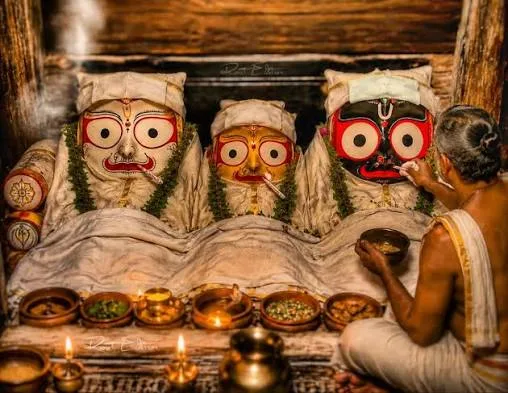
In the grand and expansive tapestry of global faiths, deities are almost universally depicted as untouchable, flawless beings who remain entirely immune to the physical vulnerabilities and messy realities of the mortal world. They sit high upon golden altars, pristine and unchanging, separated from human fragility by an absolute wall of perfection. But step into the ancient spiritual landscape of Puri, located along the eastern coast of Odisha, and you will find a living tradition that completely upends this narrative. Here, the Supreme Lord of the Universe, known affectionately as Jagannath, alongside his elder brother Balabhadra and his younger sister Subhadra, is treated not as a distant abstract energy or an unyielding stone statue, but as a deeply loved, living member of the immediate human community.
This profound and intensely emotional connection is never more evident than during the highly enigmatic Anasara ritual, a mandatory fortnight-long period where the heavy wooden doors of the twelfth-century shrine slam completely shut against the public. The underlying reason for this sudden administrative shutdown is deeply humanizing. The Lord has caught a severe, exhausting fever and must immediately go into a strict, highly secretive medical quarantine. For fifteen consecutive days, all grand public displays of opulence, royal music, and elaborate temple cuisines cease entirely, plunging the world’s largest temple complex into a state of quiet, anxious family nursing.
The entire philosophy of the Puri temple is built upon the concept of Manaba Leela, which translates directly to the divine play of mimicking human life. Because the deities are carved from sacred neem logs, they are believed to possess a organic life cycle that mirrors the biological vulnerabilities of the human body. They wake up in the morning, brush their teeth, eat regular meals, take afternoon naps, change their clothes according to the shifting seasonal weather, and eventually, they fall sick just like any ordinary human being. The Anasara ritual is the ultimate expression of this philosophy, proving that the divine does not look down upon human suffering from a position of detached comfort, but instead chooses to experience the physical limitations of sickness and isolation alongside mankind.
The Royal Bath That Triggers a Crisis
The prelude to this gripping spiritual event begins under the scorching, unyielding summer sun during the annual celebration of Devasnana Purnima, popularly referred to as the grand bathing festival. Brought out from the dark, cool confines of the inner sanctum onto an elevated, highly visible open-air bathing platform in full view of hundreds of thousands of eager, chanting devotees, the wooden deities are ritually doused with exactly one hundred and eight pots of hyper-chilled, fragrant well water. This water is drawn from a sacred, specialized well within the temple premises that is opened only once a year, and it is meticulously mixed with pure sandalwood paste, crushed camphor, exotic aromatic herbs, and rare forest distillates. It is a spectacular, high-energy public celebration meant to cool the deities down after the intense, suffocating heat of the peak Indian summer months.
However, as the ancient legends and medical texts of the temple dictate, this massive, icy ceremonial downpour takes a heavy physical toll on the deities’ organic wooden structures. By the time the sun sets on the bathing festival, the deities are believed to have developed an intense, feverish chill from standing out in the wind while completely drenched. Weakened, exhausted, and fundamentally compromised, their physical forms begin to show signs of wear, and their vibrant facial paints begin to run. Under the cover of darkness, they are quietly, carefully escorted away from their grand public thrones and placed into a specialized, deeply secluded dark chamber known as the Anasara Ghara.
This sudden transition from absolute, earth-shattering public celebration to total, silent isolation marks the official commencement of the Anasara ritual. The immediate consequence of this shift is the enforcement of a total media and public blackout. The majestic lions’ gate of the temple remains open for visitors to pray at the empty outer courtyard, but the inner sanctum is barred with heavy bamboo screens. The daily Chappan Bhog, the legendary fifty-six varieties of cooked mahaprasad cooked daily in the world’s largest earthen kitchen, is abruptly halted, replaced by the somber reality of a quiet medical ward where the only focus is the survival and rejuvenation of the sick deities.
Inside the Anasara Ghara: A Secret Tribal Kinship
The moment the deities enter this hidden quarantine room, the entire power dynamic, daily ritual routine, and administrative structure of the Jagannath Temple shifts dramatically. The standard, orthodox temple priests, known as the Brahmins, who usually manage the everyday public rituals, complex Sanskrit chants, and rigid caste-based purity rules of the outer temple, are formally asked to step aside. For the next fifteen days, the exclusive right to touch, look at, serve, and heal the sick deities is handed over entirely to the Daitapatis. This is a specialized clan of servitors who trace their biological lineage back to the ancient tribal king Biswabasu, the original forest worshipper of the deity before he was brought into the orthodox Hindu fold.
This transition is known in temple parlance as Gupta Seva, which means secret or hidden devotion. The Daitapatis view the deities not as distant masters or stone idols to be worshipped with fear and awe, but as their direct biological ancestors and family elders. Consequently, the atmosphere inside the secret chamber changes from one of grand, awe-inspiring institutional worship to the quiet, intimate, and anxious atmosphere of a family nursing a critically ill grandfather back to health. No brass bells are rung inside the chamber, no loud temple drums are beaten, and no vedic chants are allowed to echo through the corridors. The public is left completely on the outside, eagerly awaiting any minor scrap of news regarding their Lord’s internal medical recovery.
During this period, the Daitapatis live a life of strict austerity and devotion, sleeping on the cold stone floors of the temple and cutting themselves off from their own families outside to maintain the absolute sanctity of the healing process. They treat the wooden bodies of the deities with an extraordinary level of physical tenderness, applying poultices, checking the structural integrity of the wood, and speaking to the deities in hushed, conversational whispers. This ancient tribal kinship bypasses all standard scriptural rules of priesthood, highlighting a raw, unstructured form of love where humanity and divinity blur into a shared experience of vulnerability and care.
The Meticulous Ayurvedic Regimen of the Gods
What happens behind the heavy bamboo screens of the Anasara Ghara is not a series of symbolic gestures, but a highly meticulous, generationally guarded system of authentic Ayurvedic healing directed by the Raj Vaidya, who functions as the traditional royal physician of the temple administration. Because the deities are sick, they are placed on a strict therapeutic liquid diet, and all standard solid food offerings are completely forbidden. Instead, they are fed a specialized preparation known as Anasara Pana. This is a highly customized, soothing liquid blend of sweet condensed milk, compressed fresh fruit juices, and specific herbal distillates designed to rehydrate their feverish bodies, soothe their throats, and cool down their internal systems.
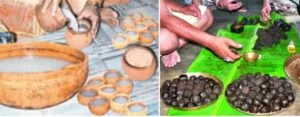
As the days of the quarantine progress, the physical medical interventions carried out by the tribal servitors become increasingly intensive and physically demanding. On the fifth day of the isolation, a highly celebrated ritual known as the Phuluri Tela Seva is performed. The deities are massaged from head to toe with a highly prized, deep-acting medicinal oil. This is not a standard, store-bought oil, but a sacred concoction prepared by a specific family of traditional pharmacists over an entire year. Pure sesame oil is infused with up to twenty-seven distinct roots, wild sprouts, and deeply fragrant forest flowers such as champa, malli, and jai. The mixture is then sealed inside heavy earthen pots and buried deep underground for twelve months to ferment into a highly potent, deeply penetrating therapeutic unguent capable of preserving wood and cooling the physical core of the deities.
Following the oil massage, from the sixth through the ninth days, the servitors apply a thick, heavy therapeutic herbal paste known simply as Osua. This paste is formulated from natural forest resins, wild roots, and pure sesame oil, applied directly over the entire wooden framework to structurally rejuvenate the seasoned neem wood and draw out any residual dampness left behind by the initial ceremonial public bath. In the final stages of the Anasara ritual, the deities are treated with cooling applications of fresh sandalwood and saffron pastes, bound tightly in layers of fine white silk cloth stretching over thirty-five feet long, and eventually completely repainted using one hundred percent natural organic vegetable and mineral dyes to restore their bright features.
The Devotee’s Longing and the Alarnath Alternative
For the millions of daily worshippers who flock to Puri from all corners of the globe, the commencement of the Anasara ritual brings with it a deep, aching sense of spiritual separation and emotional grief. The literal translation of the word Anasara means an absolute lack of opportunity to see or interact with the Lord. The vibrant town of Puri, usually bustling with loud street processions, temple music, and the distribution of hot mahaprasad, suddenly feels quiet and empty, as if the soul of the city has gone into hibernation. The emotional distress of the devotees is palpable, with many standing outside the closed temple gates for hours, staring at the blank walls and weeping for a glimpse of their ailing deities.
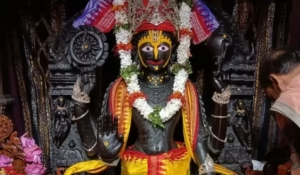
To ease this profound emotional longing and prevent total spiritual despair among the masses, a beautiful secondary tradition emerged just twenty-three kilometers away in the small, rural town of Brahmagiri. During the exact fifteen days when the main temple in Puri remains completely dark and silent, it is firmly believed that the true, uncorrupted spiritual essence and cosmic energy of Lord Jagannath temporarily migrates and manifests within the pristine, four-armed black stone deity of Lord Alarnath.
Suddenly, the massive wave of humanity shifts its direction, rerouting their spiritual journeys away from the coast of Puri and into this quiet, inland village temple. The Alarnath temple, which remains relatively peaceful during the rest of the year, becomes the temporary spiritual capital of the state. Devotees find immense solace in participating in the famous Kheer festivals here, where a rich, sweet rice pudding is offered to the deity in massive quantities. Eating this pudding during the dark fortnight is considered spiritually equivalent to receiving the blessings of Lord Jagannath himself, providing a vital psychological buffer that helps the community endure the long weeks of separation while their beloved Lord heals in complete, guarded isolation back at the main shrine.
The Grand Rejuvenation and the Chariot Call
The long, agonizing period of anxious waiting and spiritual separation finally draws to a spectacular, high-energy close on the eve of the upcoming new moon. Having successfully completed their strict fifteen-day medical isolation, weathered the peak of their fever, and absorbed the healing properties of the intensive Ayurvedic oil and herbal treatments, the deities emerge from the dark chamber in a breathtaking, highly anticipated event known as the Nabajaubana Darshan, which translates to the sight of renewed youth.
When the heavy bamboo screens are finally taken down, the sight that greets the public is nothing short of miraculous. Standing before the ecstatic crowds are the three deities, looking more vibrant, powerful, and radiant than ever before. Their eyes have been freshly painted by the master artists of the temple in a precise, secretive ritual called Netrotsava, giving them an intense, life-like gaze that seems to pierce through the crowd. Their wooden bodies have been completely reinforced, their colors are blindingly bright, and their entire aura radiates a sense of complete triumph over physical illness. The collective roar of relief and joy that erupts from the thousands of gathered devotees clears the air of the past two weeks of melancholy, signaling that the health crisis has passed and the universe is back in balance.
This entire humanizing cycle of bath, sickness, isolation, and recovery serves as the vital, non-negotiable prelude to the world-famous Rath Yatra itself. The deeper philosophical lesson of the Anasara ritual is that one must undergo isolation and healing before they can successfully lead a grand public movement. Having felt the physical pain of human sickness and experienced the humility of a dark quarantine room, the completely rejuvenated Lord is finally ready to break past all rigid institutional boundaries, step out of the elite temple walls, and ride into the crowded, muddy public streets on his massive chariot to meet the common man exactly where they stand, ensuring that no one is left behind in the journey of life.
If you found this deep dive into India’s secret traditions and ancient medical rituals fascinating, consider sharing this article within your cultural and spiritual circles, and subscribe to our newsletter below to decode more untold grassroots stories breaking across the country!
Follow us on instagram for getting daily updates and stories like this – @desibooze.
Also see-