


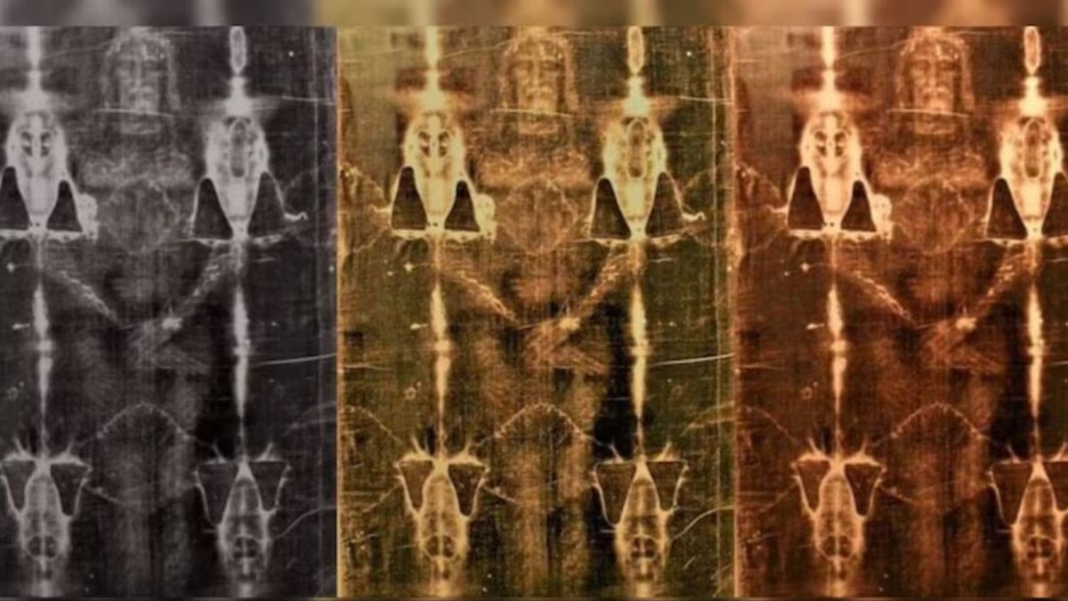
There are some stories that, when they break, make you stop mid-scroll and read the headline again. Slowly. Then a third time. Jesus Christ Had Indian DNA is exactly that kind of headline. It sounds like something cooked up in the comment sections of a conspiracy forum at 2 AM. Except this time, the source isn’t Reddit. It’s the University of Padova in Italy. And the findings have been published in a peer-reviewed preprint on bioRxiv in March 2026.
Welcome to one of the strangest — and most genuinely fascinating — intersections of modern science and ancient faith you’ll read about this year.
What the Italian Researchers Actually Found
The study at the centre of all this noise is titled “DNA Traces on the Shroud of Turin: Metagenomics of the 1978 Official Sample Collection.“ The research was led by Dr. Gianni Barcaccia, a plant genetics and genomics professor at the University of Padova, Italy, who has now dedicated the better part of a decade to studying the genetic material found on the Shroud of Turin — the 14.4-foot-long linen cloth that Christianity traditionally holds to be the burial cloth of Jesus Christ.
The shroud, currently housed in the Cathedral of Saint John the Baptist in Turin, Italy, has been under scientific scrutiny since at least the 1970s. DNA analysis of the shroud by Italian researchers found that the yarn used to make the shroud may have come from the Indus Valley — and that about 40 per cent of the human DNA found on the shroud is from Indian lineages.
Let that number sit for a second. Forty percent. Not a trace. Not a footnote. Nearly half of all identifiable human genetic material on the most studied Christian artefact in history traces back to the Indian subcontinent.
The new 2026 study expands significantly on earlier findings, using more advanced sequencing techniques to reveal the Indian connection. Researchers analyzed dust particles vacuumed from the shroud in 1978 and found a remarkable mix of DNA from multiple people, plants, and animals.
The Cloth That Has Touched the Entire World
Before anyone starts jumping to conclusions about Jesus taking yoga classes in Rishikesh, it is worth understanding what the researchers are actually claiming — and what they are not.
The shroud is not just cloth. It is, genetically speaking, a time capsule of every hand that has ever touched it, every room it has been stored in, and every culture it has passed through. The shroud carries diverse medieval and modern DNA. It is contaminated with not only human DNA but that from cats, dogs, chickens, cattle, goats, sheep, pigs, horses, and wild animals such as deer and rabbits. DNA from carrots, wheat, peppers, tomatoes, and potatoes are also present.
The potatoes alone are a clue. Potatoes did not exist in Europe before Christopher Columbus returned from the Americas in the late 15th century. Their presence in the DNA tells us the shroud was accumulating environmental contamination well into the modern era, which means the cloth has been in active contact with human hands from multiple centuries and multiple continents.
So when 40 percent of the human DNA maps back to Indian lineages, the researchers offer two possible explanations. The presence of approximately 38.7 per cent of Indian ethnic lineages could have resulted from historical interactions or the Romans importing linen from regions near the Indus Valley, associated with the term ‘Hindoyin’ found in rabbinic texts.
The second explanation is more structurally interesting: the DNA traces found on the Shroud of Turin suggest the potentially extensive exposure of the cloth in the Mediterranean region and the possibility that the yarn was produced in India. In other words, the fabric itself — the linen thread — may have been spun and woven in ancient India before being exported to the Mediterranean world.
This is not implausible. Trade between ancient India and the Roman Empire was not a curiosity — it was the backbone of the ancient global economy. The port of Muziri on Kerala’s Malabar Coast was one of the busiest trading hubs of the ancient world, sending spices, textiles, and dyed cloth westward on Roman and Arab ships centuries before Christ was born.
India Was Never as Far as We Were Taught
Here is where the story gets bigger than just a scientific paper. The Indian connection to the earliest days of Christianity is not new. It is ancient, documented, and very much alive in the southern state of Kerala.
The tradition of origin among Saint Thomas Christians relates to the arrival of Thomas, one of the 12 disciples of Jesus, at the ancient seaport Muziris on the Kerala coast in AD 52. This community — the Saint Thomas Christians, also called Nasranis — has maintained for nearly two thousand years that Jesus’s own apostle walked on Indian soil, preached in Malayalam-speaking lands, and established seven foundational churches across Kerala.
The most compelling evidence for St. Thomas’s legacy in India is the living testimony of the Saint Thomas Christians. This distinct ethno-religious community, primarily located in Kerala, maintains an unbroken tradition that St. Thomas the Apostle landed in Muziris in 52 CE. They believe he established seven foundational Christian communities in Kerala, including significant sites like Kodungallur and Mylapore.
What makes this tradition extraordinary is that it did not develop inside a church. It developed inside a caste system. Nearly all those who accepted the teachings of Saint Thomas were devout Brahmins of the highest level — Nambudiri and Nair — who were Shaivites of the strictest order. So strict and correct were they in their Brahminical character and observance that they were frequently asked by the other Hindus to perform the rites of purification for defiled objects and even Hindu temples.
Christianity, in Kerala’s oldest telling, did not arrive as a foreign religion. It merged with the Brahminical traditions already there. One Kerala priest put it plainly: “We are Christians in faith, and we are Indian in citizenship, and we are Hindus in culture.”
This is not mythology. A number of 3rd- and 4th-century Roman writers also mention Thomas’s trip to India, including Ambrose of Milan, Gregory of Nazianzus, Jerome, and Ephrem the Syrian, while Eusebius of Caesarea records that Clement of Alexandria’s teacher Pantaenus visited a Christian community in India in the 2nd century using the Gospel of Matthew in the Hebrew language.
Centuries before Vasco da Gama set sail looking for spices and found Christians instead, India was already part of the Christian story.
What the Science Allows Us to Conclude (And What It Doesn’t)
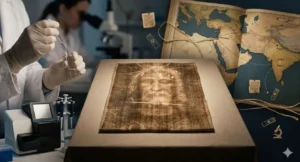
Dr. Barcaccia, to his credit, has been careful about what these results mean. When asked directly about the shroud’s origin in earlier correspondence with Live Science, he was precise: “Individuals from different ethnic groups and geographical locations came into contact with the Shroud either in Europe or directly in their own lands of origin — Europe, northeast Africa, Caucasus, Anatolia, Middle East and India. We cannot say anything more on its origin.”
What his research does allow is a very specific structural claim: the oldest DNA snippets — which tend to be shorter because DNA breaks down over time — come from genetic lineages typically found only in India. That finding suggests that the shroud was manufactured in India before somehow making its way to Europe, as Indians had little contact with Europeans at the time of its origin.
This is different from saying Jesus was Indian. This is saying: the cloth that touched Jesus — if it touched anyone — was made in India.
In 1988, scientists utilized radiocarbon dating and accelerator mass spectrometry to conclude that the Shroud was created between 1260 and 1390, raising questions about its association with Jesus. Nonetheless, this late medieval dating remains a point of contention among some Christian scholars. A separate 2025 study also found that the image formation on the shroud was consistent with medieval sculpture techniques rather than a human body imprint. The science is contested. The conversation is ongoing.
But what is no longer contestable is the Indian thread running through the cloth — literally.
Why This Matters Beyond the Headlines
When the headline reads “Jesus Christ was Indian?” the algorithmically-correct response is to laugh, share it, and move on. But there is something more quietly important happening in this research.
For most of recorded Western history, the story of Jesus has been told as a West Asian story that became a European story. Rome, Jerusalem, Bethlehem, Vatican — these are the coordinates. India was peripheral. A place where Thomas, the doubter of the group, ended up. A footnote.
The DNA evidence from Turin, combined with the living traditions of Kerala’s two-thousand-year-old Christian communities, and the documented textile trade between ancient India and Rome, builds a different picture. India was not peripheral to the ancient world. It was central. Its cloth, its spices, its port cities were the arteries through which the ancient Mediterranean economy breathed.
If the most sacred cloth in Christianity was woven in India, it is not coincidence — it is evidence of how deeply India was integrated into the ancient world’s supply chain of culture, commerce, and faith.
The viral headline about Jesus having Indian DNA deserves more than a laugh. It deserves the question it is actually asking: How much of what we think we know about the ancient world was written without India in the room?
DesiBooze Editorial
Here at DesiBooze, we have a soft spot for the moments when India walks into a room it was never invited to and turns out to have been there first. This is one of those moments — except it was not a room. It was the most scrutinised piece of cloth in human history, and 40 percent of the DNA on it says namaste. We are not here to claim Jesus as desi. Science does not work that way, and neither does faith. What we are here to say is that the ancient world was messier, more connected, and more Indian than most Western textbooks have been comfortable admitting. The linen may have come from the Indus Valley. The apostle almost certainly landed in Kerala. The trade routes were real. The Nasrani Christians of Kerala are real — still there, still singing liturgy in Syriac, still tracing their ancestry to a fisherman from Galilee who arrived on a Malabar beach in 52 AD. That is not a conspiracy theory. That is two thousand years of unbroken memory. And if Italy’s finest geneticists are now finding it in the DNA of a medieval cloth, maybe it is time the rest of the world catches up.
Enjoyed this? Share it with someone who thinks history is boring.
Follow DesiBooze for more stories that make you rethink everything you thought you knew.
Also see-