

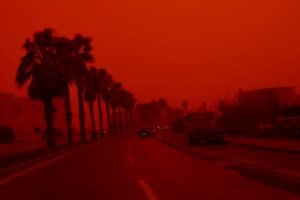
They said red skies were an Australian thing. The kind of image you associate with the outback, iron-rich red soil, and cyclones tearing across the Pilbara. But on April 1, 2026, the Greek island of Crete woke up to something that made people question where they were on the planet. The sky had turned blood red. Not at sunset. Not through a filter. At midday.
What descended on Crete was not a local weather event and it was not a fluke. It was one of the most intense Saharan dust intrusions the eastern Mediterranean has witnessed in years — and it brought with it a chaos that shut airports, overturned trucks, closed schools, flooded streets, and sent thousands of residents and tourists scrambling indoors with masks on. The name of the system responsible: Storm Erminio.
When the Sky Stopped Looking Like a Sky
The dust cloud reached Crete around midday on Wednesday, April 1, and persisted well into April 2. Satellite imagery showed the island still sitting under the cloud early on Thursday morning. The dust was carried north by strong southern and south-easterly winds linked to Storm Erminio, which also brought heavy rain, thunderstorms, and a red weather warning for parts of Greece.
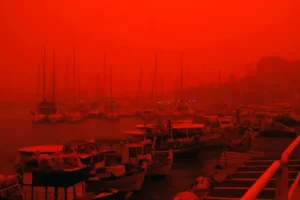
What residents experienced on the ground was something out of a science fiction film. Sandra Kypriotaki, a resident of Heraklion, described it to The Telegraph in words that have since gone viral: “It was apocalyptic, it was like something out of a Mad Max movie. The whole thing was really weird. I’ve never seen it this bad. The sky went yellow, and then it went orange, and then it turned blood red. You could hardly believe the colours were real. Our eyes were itchy, and we could feel that we were inhaling dust. The schools are closed, so the kids are at home.”
That is not a dramatic exaggeration. Air quality stations recorded dust concentrations above 1,000 micrograms of particles per cubic meter of air in parts of the island — far above normal background levels, and among the highest measured there in recent years. For context, the EU’s safe daily limit for PM10 particles is 50 micrograms per cubic meter. Crete was recording twenty times that figure.
The phenomenon is known as “calima” — when dust blows over from the Saharan desert — however experts warned that this calima was more extreme than normal.
Storm Erminio: The System Behind the Chaos
Storm Erminio was not just a dust event. It was a full Mediterranean low-pressure system that merged with a massive Saharan dust plume to create what meteorologists are already calling one of the most disruptive weather combinations Greece has faced in the current decade.
Storm Erminio swept across Greece, causing gale-force winds and extreme flooding which halted travel and damaged roads and buildings. A Polish man, reported to be in his 50s, was killed in Nea Makri, north-east of Athens, after he became trapped under a vehicle in rushing flood water. Emergency services received over 674 calls for help from Wednesday overnight into Thursday, the majority in the Attica region around Athens.
In Crete specifically, the storm, accompanied by fierce winds and a tornado, painted the sky orange and led to significant disruptions in air travel. Flights into Heraklion, Crete’s main airport, were diverted as visibility dropped to dangerous levels. On the ground, the tornado overturned trucks and caused severe damage to buildings in coastal towns like Ierapetra.
Heraklion International Airport saw visibility drop to a mere 200 meters, while Athens International Airport absorbed massive disruptions and rerouted inbound European traffic. British Airways from London was diverted to Corfu. SKY Express and easyJet flights from Manchester and Milan were severely delayed. Ferries across the Aegean were suspended entirely. The disruption hit squarely during Greece’s busy pre-Easter travel window, affecting both domestic holidaymakers and international tourists.
Why Does the Sky Turn Red? The Science Is Simpler Than You Think
There is a reason both Australia and Crete have been producing the same blood-red imagery. The physics is identical.
The reason specifically for the red sky is that Saharan dust is rich in iron, which results in the reddish hue. In Australia, the sand in northwestern Australia is also rich in iron, with the bulk of iron ore production in Australia being in Western Australia. Lead International Forecaster Jason Nicholls confirmed that the dust storms from Algeria, Crete and Egypt during this period are all related to winds produced by Storm Erminio as it slowly drifted eastward across Europe.
The orange-red colour comes from how sunlight interacts with mineral dust. The particles scatter shorter wavelengths of light and let more red light through, especially when the sun sits low. That is what gives the sky that eerie, almost cinematic glow. When the dust drops close to the surface rather than staying high in the atmosphere, it becomes gritty, smells earthy, and leaves visible deposits on every surface it touches.
The science is clear. But the scale of what hit Crete on April 1 was unusual even by Mediterranean standards. According to Mark Parrington, Senior Scientist at Copernicus Atmosphere Monitoring Service (CAMS): “It just shows that we are connected across borders and across continents by the composition of the atmosphere.”
Health Consequences: This Is Not Just a Visual Event
Behind the photographs and the apocalyptic footage shared millions of times on social media is a serious public health story that is not getting enough attention.
Health authorities on Crete issued a warning that the high concentrations of dust particles could cause breathing difficulties, particularly for young children, elderly people and those who suffer from conditions such as asthma. Masks became essential outdoor gear. Schools remained closed. Residents were urged to keep windows shut and avoid all non-essential movement.
Researchers in Crete and southern Greece have linked extreme dust episodes to spikes in emergency room visits for respiratory issues, especially when the particles stay near the ground for extended periods. The fine mineral particles in Saharan dust are large enough to pass into the lungs, where they irritate airways and compound existing respiratory conditions.
The UN’s World Meteorological Organization has been sounding the alarm on this for years. A WMO report found that sand and dust storms are leading to premature deaths due to climate change, with more than 330 million people in 150 countries affected. Assembly President Philemon Yang stated the storms “are fast becoming one of the most overlooked yet far-reaching global challenges of our time.”
Is Climate Change Making This Worse?
The short answer is: almost certainly yes, though the full picture is still being studied.
Higher temperatures, drought and higher evaporation lead to lower soil moisture, and if you combine those effects with poor land management, it is conducive to more sand and dust storms. There is also some speculation that changes in atmospheric circulation linked to the effects of climate change may increase the frequency of Saharan dust storms reaching Europe.
The numbers back this up. For dust originating in Africa, there have been growing effects on the Mediterranean region over the past five decades. The western Mediterranean has seen a rising trend in the frequency of sand and dust storms, with an average increase of 0.7 dust days yearly since 1948.
Crete lies directly in the firing line. It sits downwind of North Africa under southerly and south-easterly wind conditions, which means it often receives the first and strongest hit in Greece when Saharan dust is on the move. What changed in April 2026 is not that dust reached Crete — it is how much arrived, how fast it arrived, and what it combined with when it got there.
What Happens Next
As of April 3, Storm Erminio is moving eastward. The same dust cloud that painted Crete red moved on to Egypt on April 2 and is expected to affect parts of the Middle East through the weekend before the system weakens and disperses. Forecasters expect Crete to return to normal visibility by this weekend, though another wave of Saharan dust cannot be ruled out in the days ahead.
For the tourism industry, the timing could not have been worse. Greece’s Easter travel season is its most economically significant period of the year, and the combination of flight diversions, ferry suspensions, and health warnings has already disrupted thousands of itineraries. Airlines operating under EU261 regulations are legally obligated to provide accommodation and meals for passengers stranded by overnight delays, though the “extraordinary weather” clause means cash compensation is unlikely.
The clean-up in Crete, Ierapetra, and the broader Attica region will take days. The body count — one confirmed death, a Polish national swept away by floodwater near Athens — is a reminder that these events are not just spectacular. They are dangerous.
DesiBooze Editorial
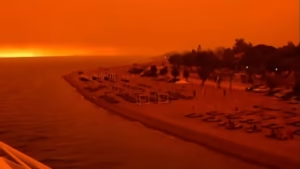
Red sky. Blood-orange air. Trucks overturned on an island that most people associate with clear blue water and white-washed houses. There is something genuinely disorienting about watching Crete look like Mars. But here is what DesiBooze thinks deserves more attention than the apocalyptic photos: this is not a freak event. It is a pattern. Australia had its red skies from iron-rich cyclone dust. Crete just had its version, delivered by a Saharan storm that travelled thousands of kilometres across the Mediterranean before landing on a beach town and shutting down airports. The WMO has already declared 2025–2034 the UN Decade on Combating Sand and Dust Storms. Science is saying clearly that these events are becoming more frequent, more intense, and reaching further than they used to. The world is getting dustier — and the places that will feel it first are not the ones most people worry about. They are the beautiful, sun-drenched ones. The ones people book flights to see. Pay attention.
Enjoyed this? Share it with someone who thinks the weather is boring.
Follow DesiBooze for stories that make you rethink everything.
Also Read: