




Have you ever bought something just because it was on “limited-time sale”? Or trusted a restaurant simply because it had a long line outside?
Believe it or not, many of your daily decisions are influenced by psychological tricks used by brands, marketers, and even people around you. These techniques are based on concepts studied in Psychology and are designed to influence how you think and choose.
Here are 10 powerful psychological tricks that secretly control your decisions.
1. The Anchoring Effect
The Anchoring Effect occurs when the first number you see influences your perception of value.
Example:
If a shirt shows ₹4,999 crossed out and ₹1,999 as the sale price, your brain automatically thinks it’s a great deal—even if the real value was never ₹4,999.
2. Scarcity Principle
The Scarcity Principle makes people want something more when it appears limited.
That’s why websites show messages like:
-
“Only 2 items left!”
-
“Offer ends in 10 minutes!”
Your brain feels urgency and pushes you to buy quickly.
3. Social Proof
Humans naturally follow what others are doing.
The Social Proof explains why products with thousands of reviews and ratings sell faster.
If many people approve something, our brain assumes it must be good.
4. The Halo Effect
The Halo Effect happens when one positive quality makes us believe everything about something is good.
For example, if a celebrity promotes a product, people automatically think the product must be great—even if they’ve never tried it.
5. The Decoy Effect
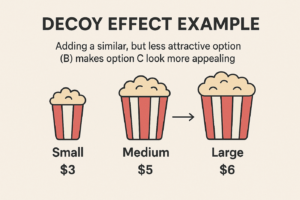
The Decoy Effect is often used in pricing.
Example:
Small popcorn – ₹200
Medium popcorn – ₹350
Large popcorn – ₹370
Most people choose the large popcorn because it suddenly feels like the best value.
6. Loss Aversion
The Loss Aversion explains why people fear losing something more than gaining something.
For example:
“Don’t miss this offer!” or “Last chance!” pushes people to act quickly to avoid losing the deal.
7. The Framing Effect
The Framing Effect means people react differently depending on how information is presented.
Example:
-
“90% fat-free” sounds healthier than
-
“Contains 10% fat”
Both statements mean the same thing, but the framing changes perception.
8. Authority Bias
People tend to trust experts or authority figures.
The Authority Bias explains why ads often feature doctors, scientists, or professionals recommending products.
We assume they must know better.
9. Reciprocity
The Reciprocity Principle makes people feel obligated to return a favor.
That’s why brands give free samples, trials, or gifts. Once you receive something free, you’re more likely to buy from them.
10. The Bandwagon Effect
The Bandwagon Effect explains why people jump onto trends.
When something becomes popular—like a viral product or trending fashion—more people follow simply because others are doing it.
Why Understanding These Tricks Matters
These psychological techniques are used everywhere—from shopping apps and advertisements to politics and social media.
Once you understand them, you become more aware of how decisions are influenced, allowing you to make smarter choices instead of being subconsciously manipulated.
👉 Love learning mind-blowing psychological facts like this? Follow desibooze for more viral insights, trending stories, and fascinating facts you’ll want to share with everyone! 🧠🔥
Also See –